
Healthcare Design // UI/UX // Enterprise App // Systems Design // Rapid Prototyping
Baseline
Matching patients and providers without stigma
OPENING UP ABOUT THE UX OF DENTISTRY.
A critical health need neglected by thousands
Finding a dentist for those affected by trauma, with complex care needs, or a part of vulnerable populations can be especially hard. Dentistry is an incredibly stigmatized field, that's often portrayed poorly in media, despite our universal need for it and it's overarching impacts on our health. Avoiding it because of factors like price, not being able to be understood or sheer fear can have ripple effects in one’s health.
Bridging support gaps in care
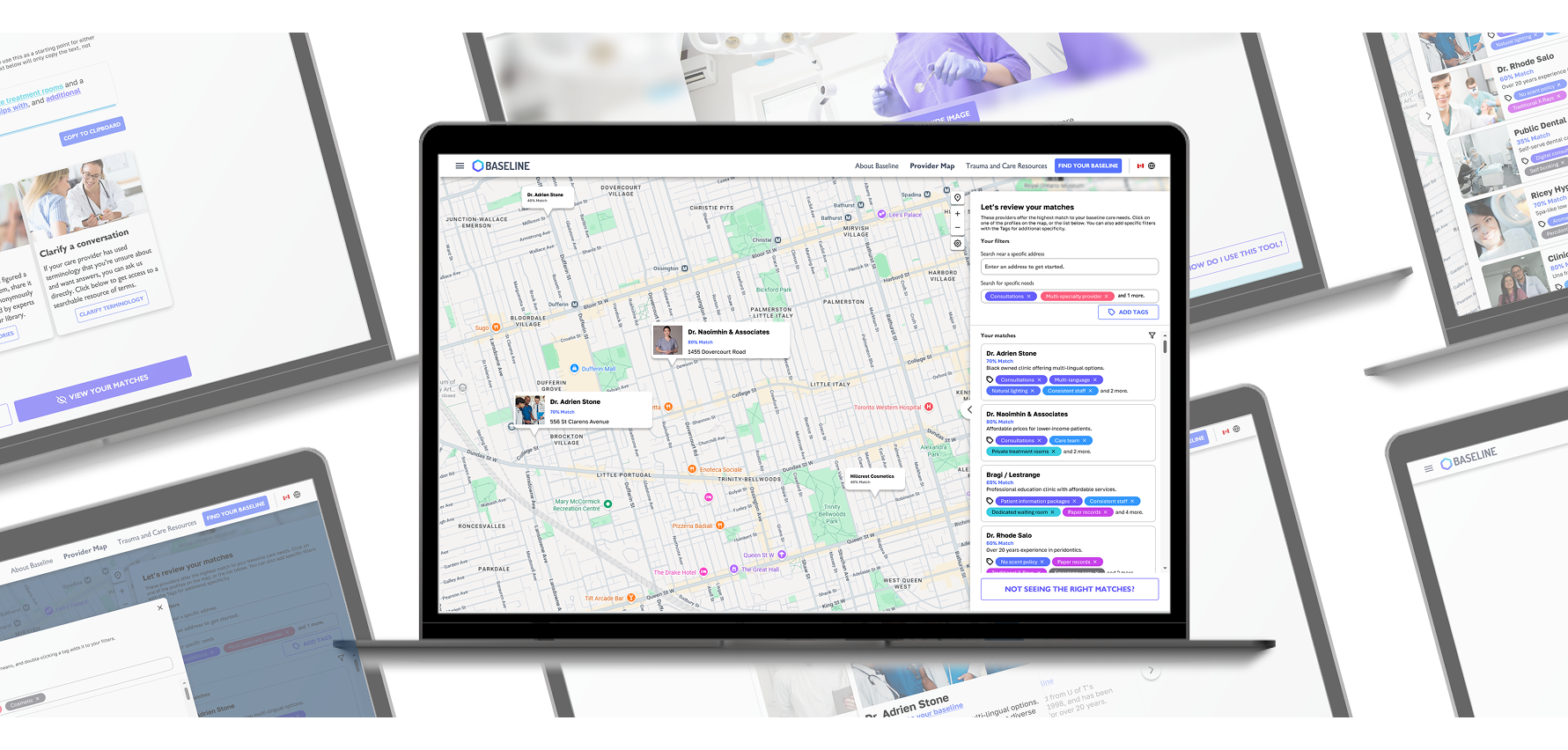
Baseline eases the journey of seeking care by meeting patients where they are. By combining the user experience and interface patterns of online dating with the dense field of dentistry, patients can match with dentists by finding the things that bring them comfort, or avoiding triggers. Baseline connects patients with complex needs to existing practitioners through smarter filtering, accurately identifying patient care needs, and making conversations with dentists go smoother each time.
Bridging patient and dentists through better communication
Baseline is a login-less, data-sensitive care portal that matches patients and dental care providers based on experiential factors and complex care needs, not simply procedures. Baseline aims to help patients accurately identify their needs, connect them to clinics that provide them, and build better relationships between dental patients and providers through agency and honest communication.
The Challenge

A problem more complicated behind the scenes - experiential signs dentistry needs change.
Dentistry is a ''necessary discomfort'' to countless worldwide. But for many, the experience of vulnerable, exposed medical procedures can be incredibly taxing to the point of complete avoidance. Dental care provides a cascade of health impacts, and when it fails the body as a whole can bear the impacts. So by focusing on the patient groups needing the support the most, we reduce care needs for many patients down the line.
Through both clinical research at the University of Toronto, and first-hand interviews with dental practitioners, I identified these three challenges in the clinical and interpersonal relationships within the dental care field:
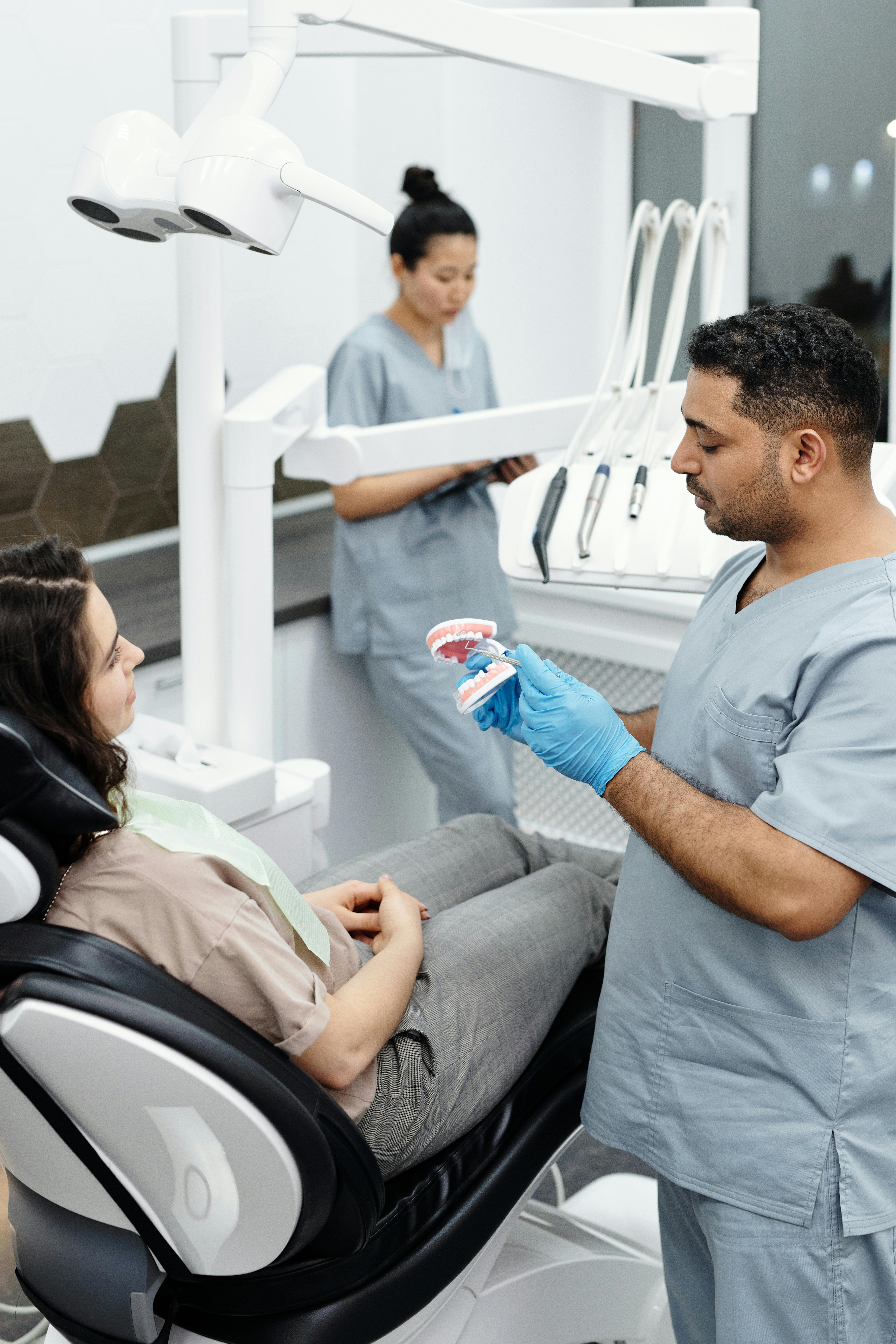
Limited information
Information about patients has to be boiled down to the bare essentials to keep up with care, leaving professionals to figure things out only when a patient is in front of them.
''...the phrase ''Open Wide'' has become synonymous with the real beginning of dental data gathering'' (Bain, Crawford A) indicating a strong lack of knowledge gathering pre-appointment.
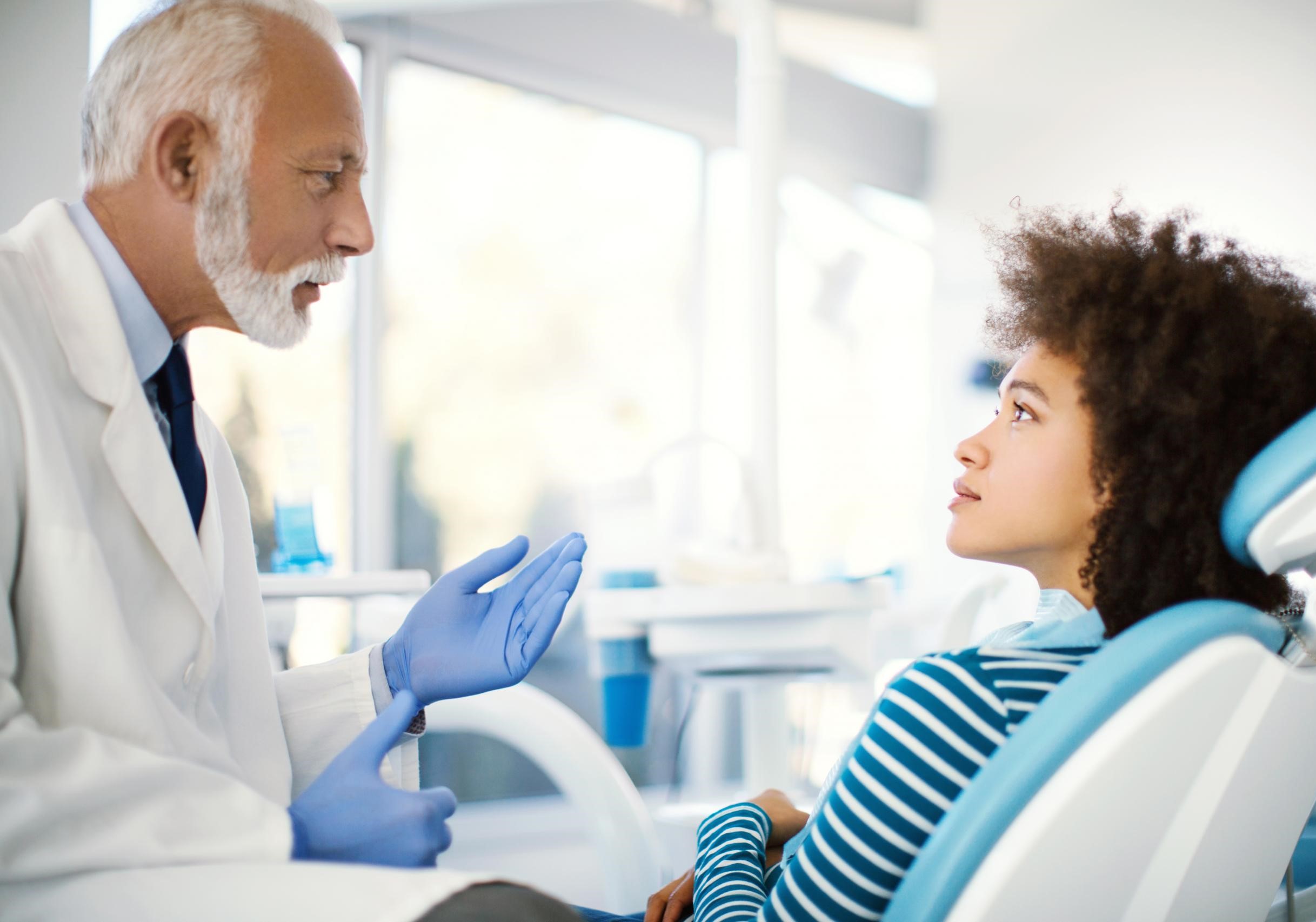
Limited control
There's hardly a time before you're in the chair to speak to your dentist or care provider. And not meeting or speaking before-hands can lead to a sense of unease or lack of agency.
''Numerous studies have shown that (if) the patient believes that (they have) some control over the potential threat in dentistry, their overall fear decreases drastically.'' (Lazare, Marc, D.D.S)
Limited knowledge
There are too many clinical barriers limiting understanding of complex information, especially in the discussion of treating cases that fall outside the traditional.
''...Using open-ended questions or fields to cover clinical background history has proven to help remove tension or the clinical feel.'' (Stefanac)
IMPACTING THE PROBLEM ON BOTH FRONTS
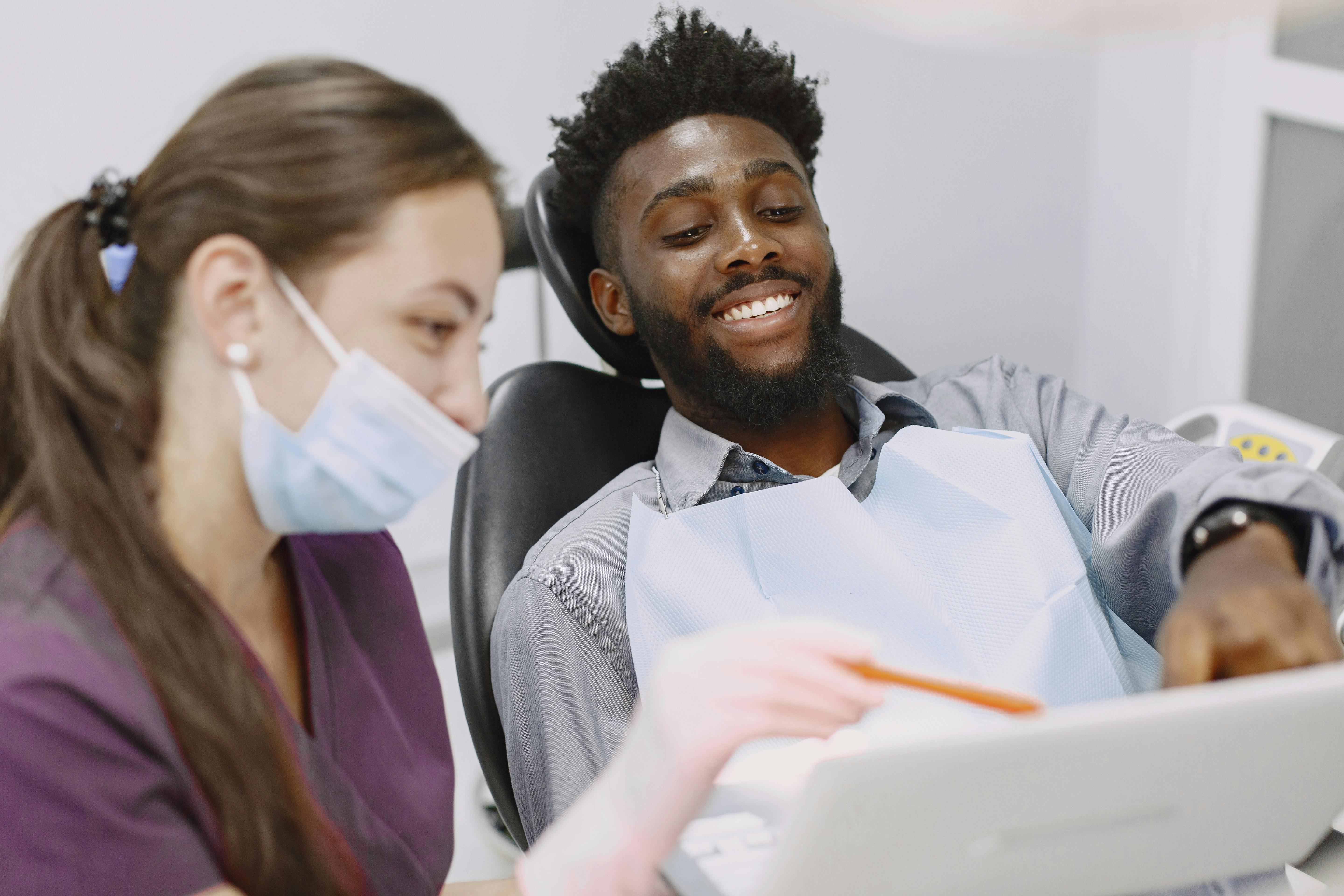
What if we could have patients connect directly to the best fitting clinics?
There is tremendous pressure being put on both sides of the care relationship, where patients put themselves in situations with obstacles like trauma, language, or sensory issues and providers are left attempting to navigate clients with complex needs who differ from average. By providing a service that allows patients to self-sort themselves to the offices or clinics that support their complex needs, and helping patient articulate those needs clearly, barriers to care slowly erode not by further training or patient endurance, but better conversation.
THIS IS BASELINE
Providing patients better dental care through prioritizing experience.
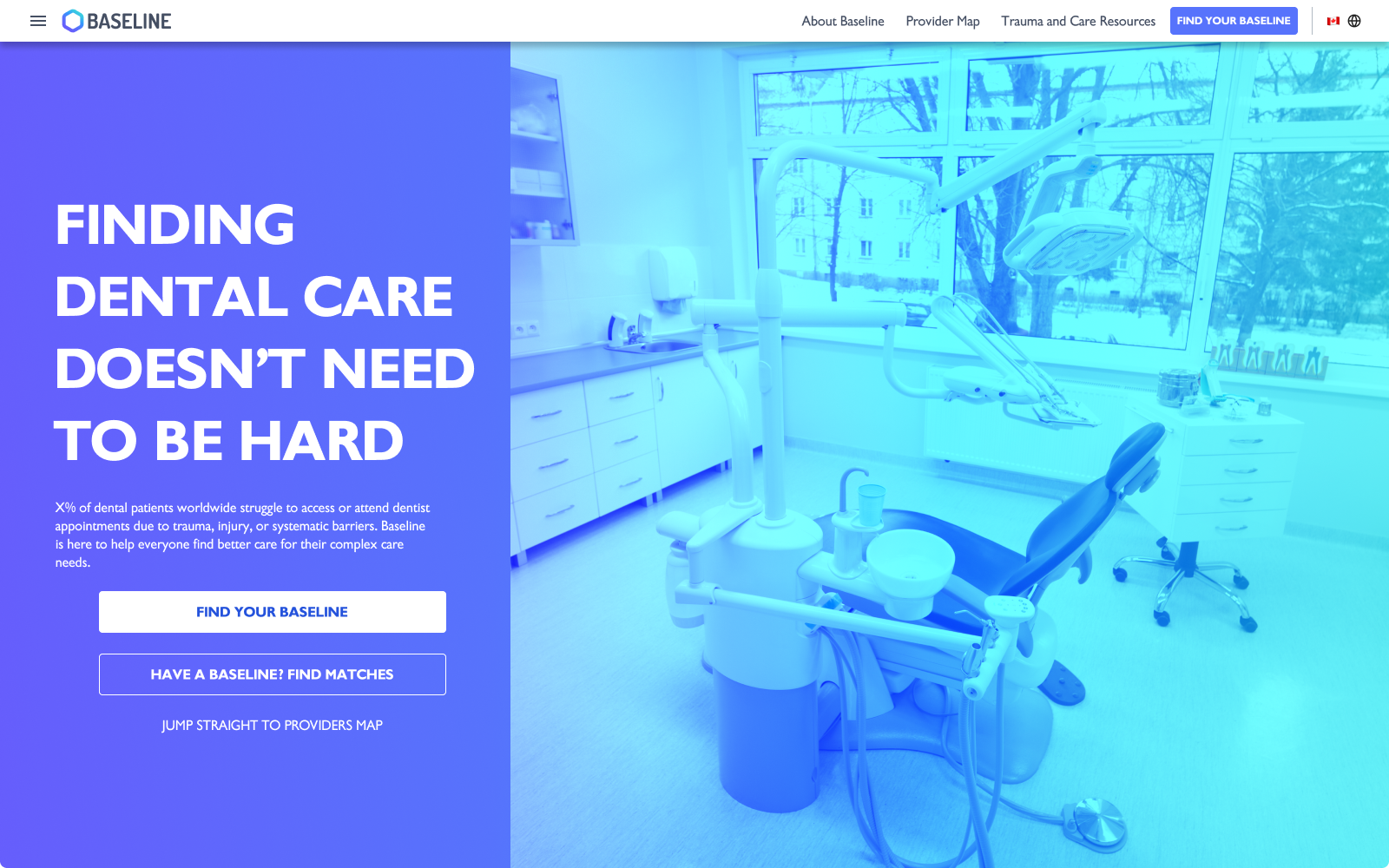
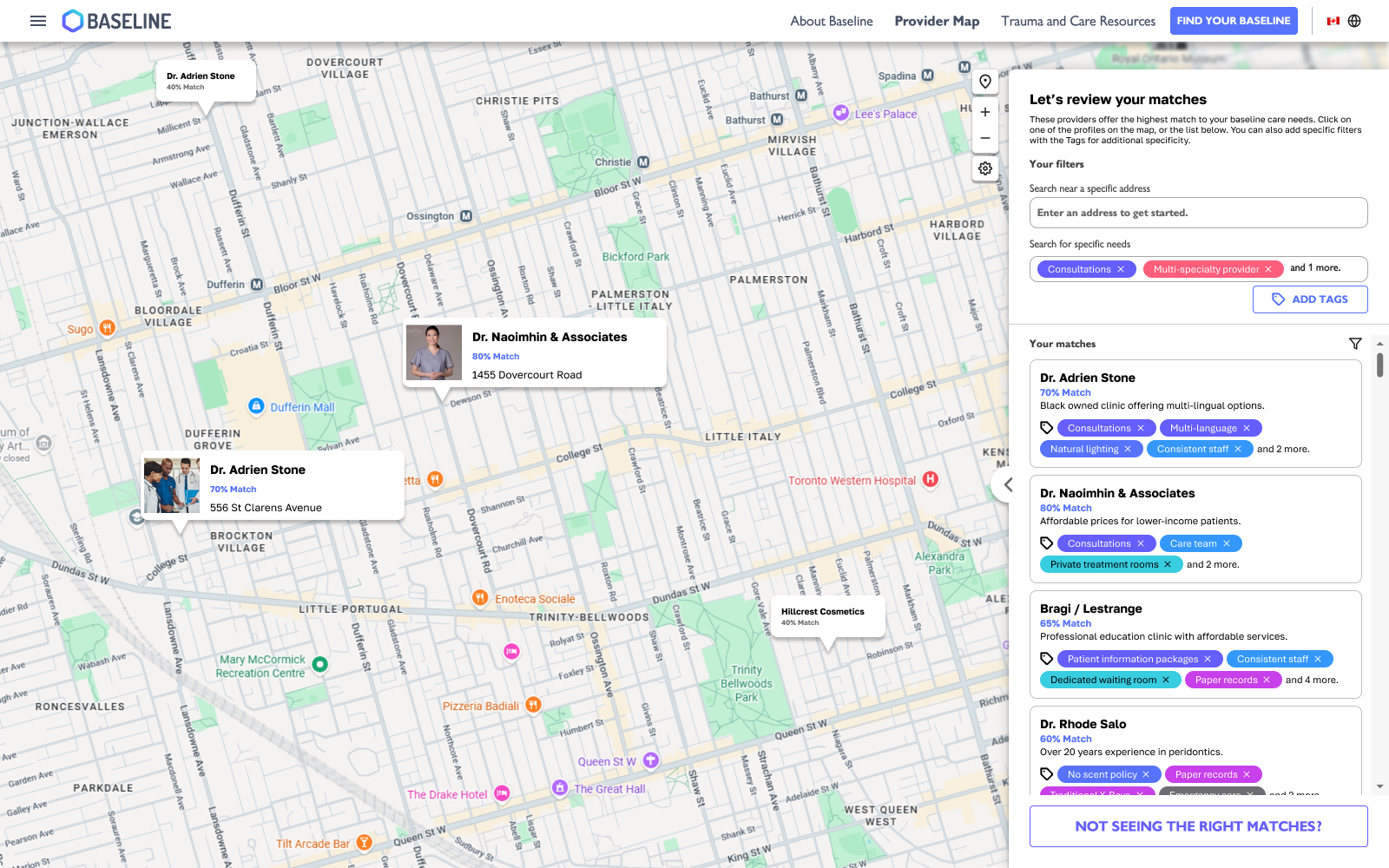
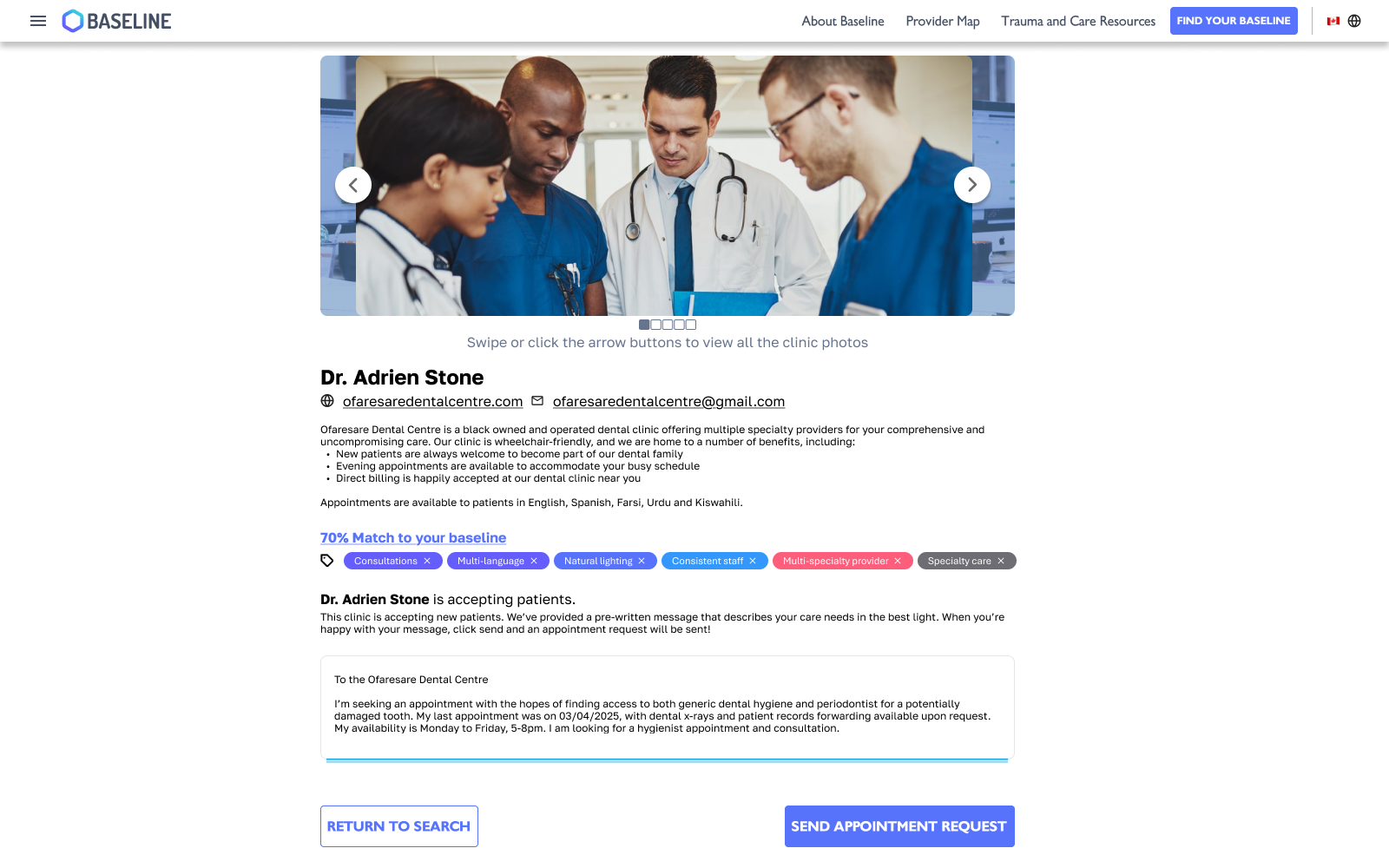
Baseline is a patient and practice matching service, that bridges the gap between unique patient demographics and providing for complex care needs. Baseline addresses three major problem spaces: accurately identifying care needs, connecting patients to practitioners, and improving dental visits through better communication.
FINDING YOUR BASELINE NEEDS
Building your care profile without traditional forms.
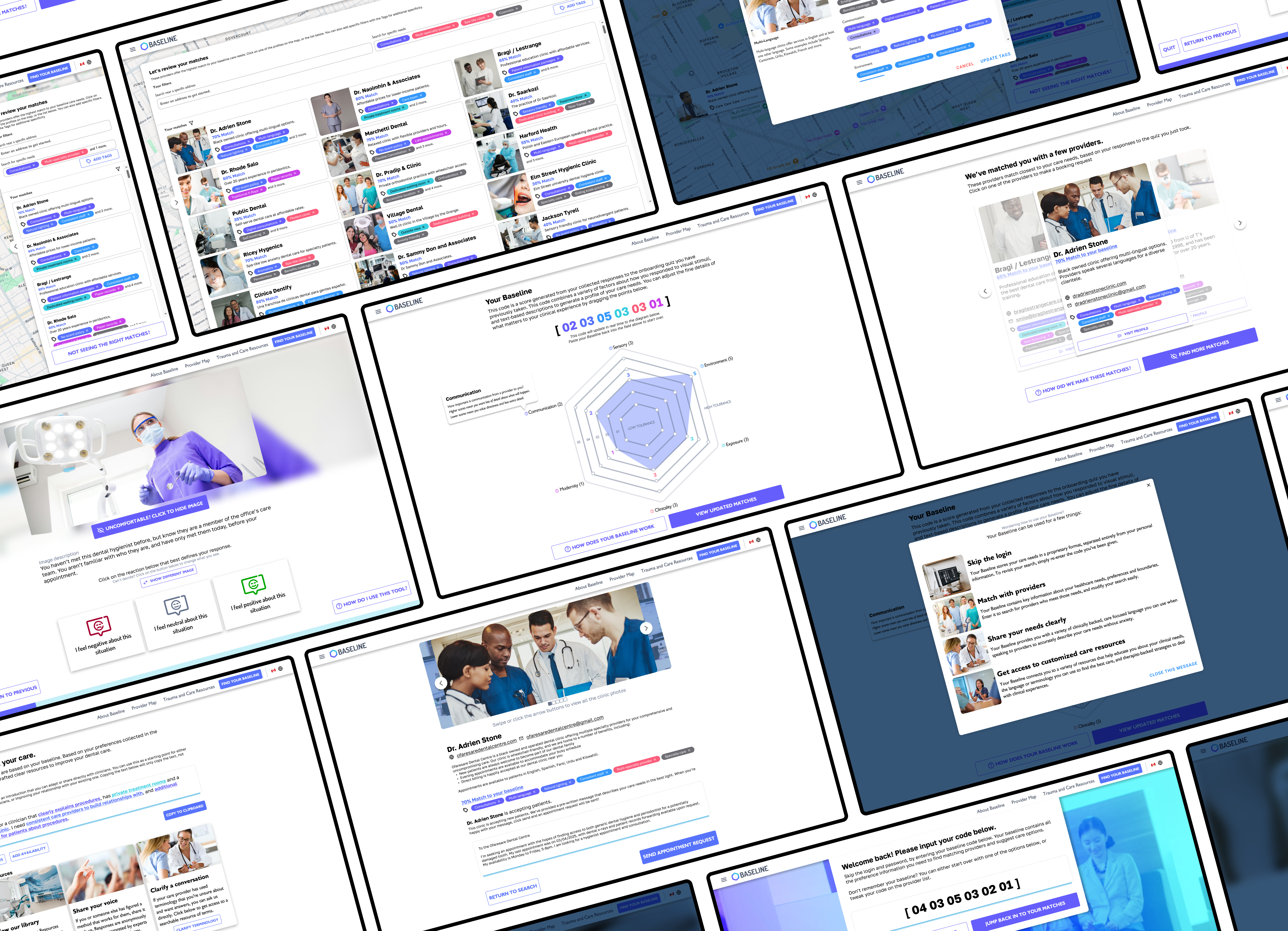
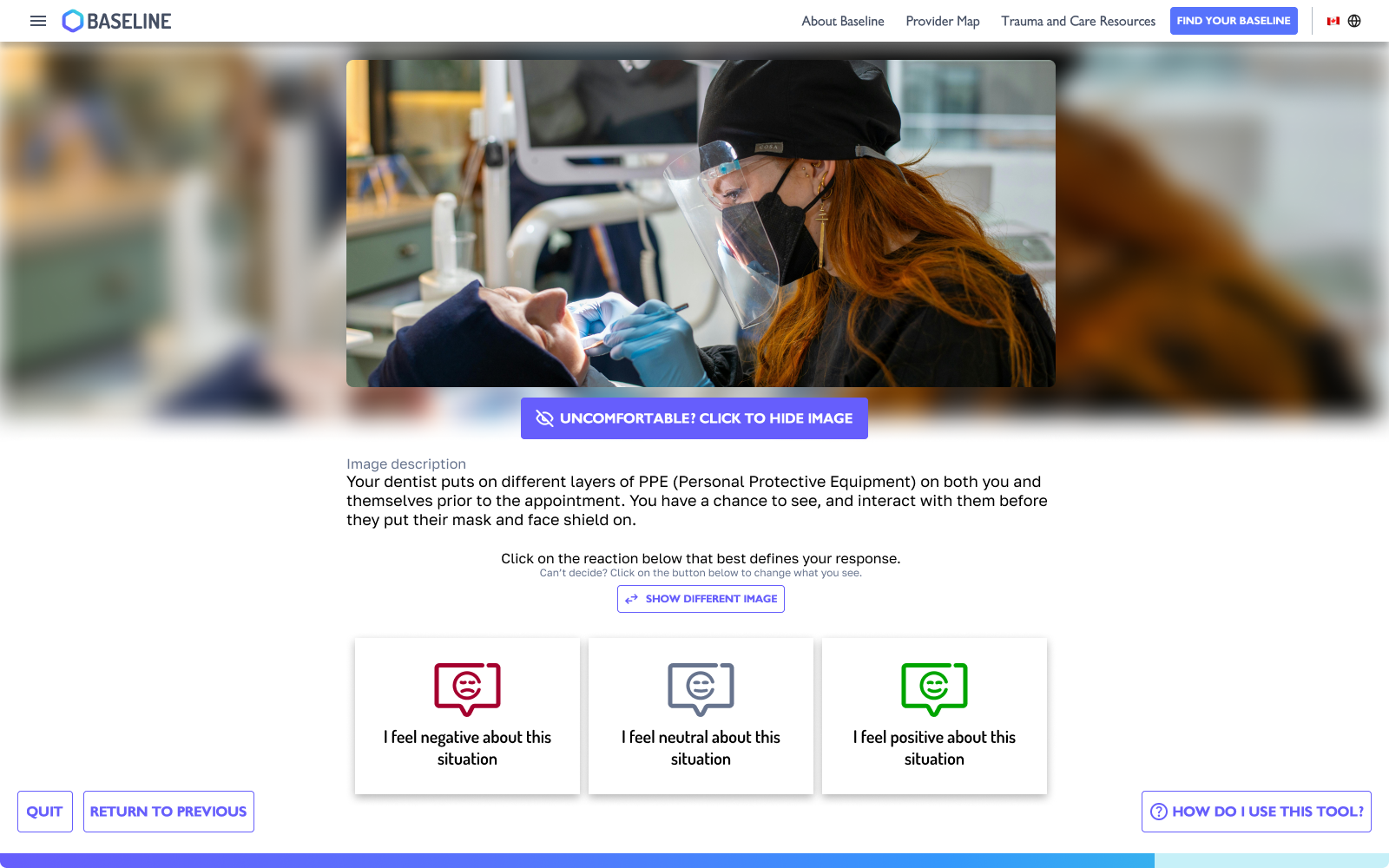
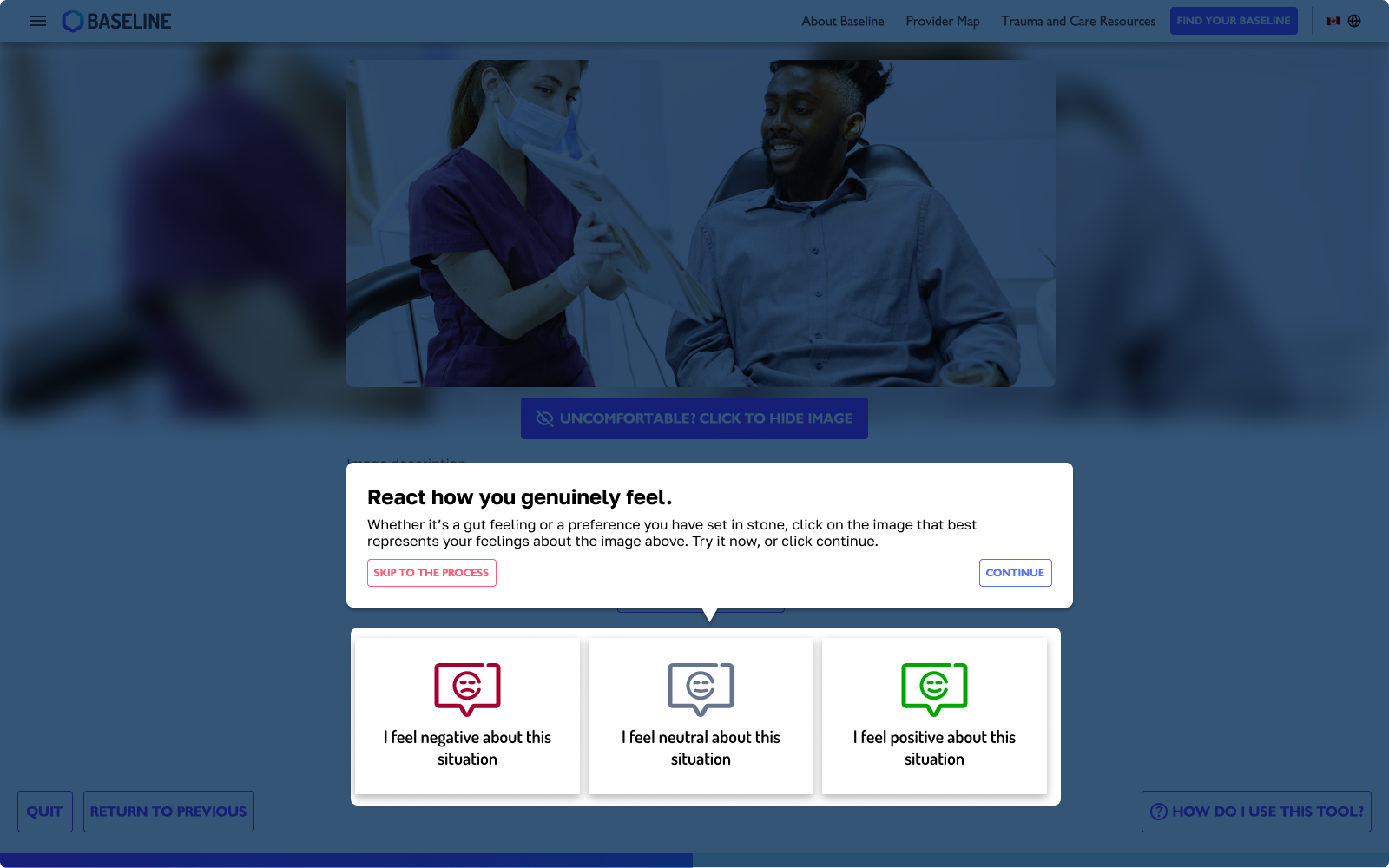
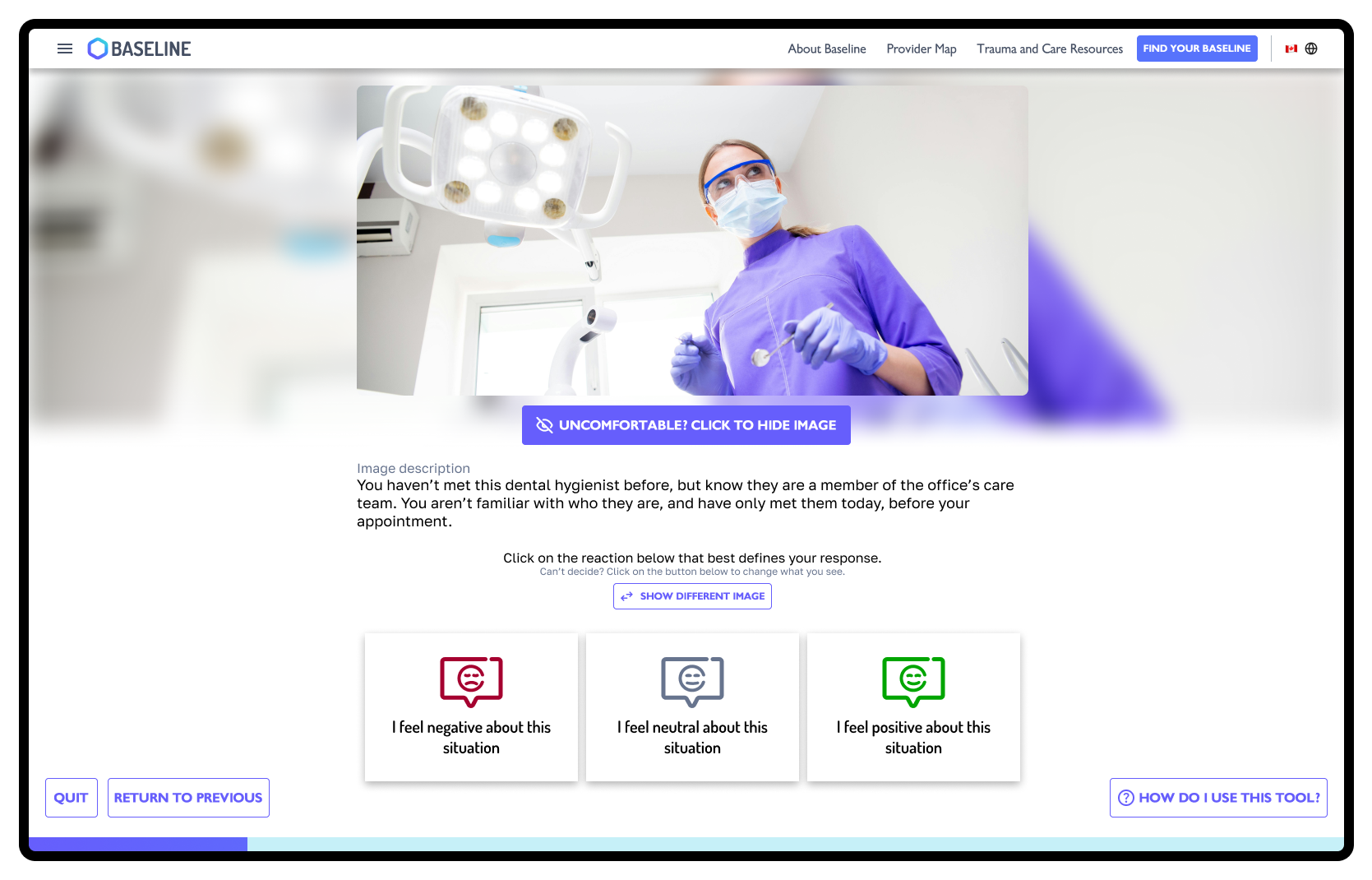
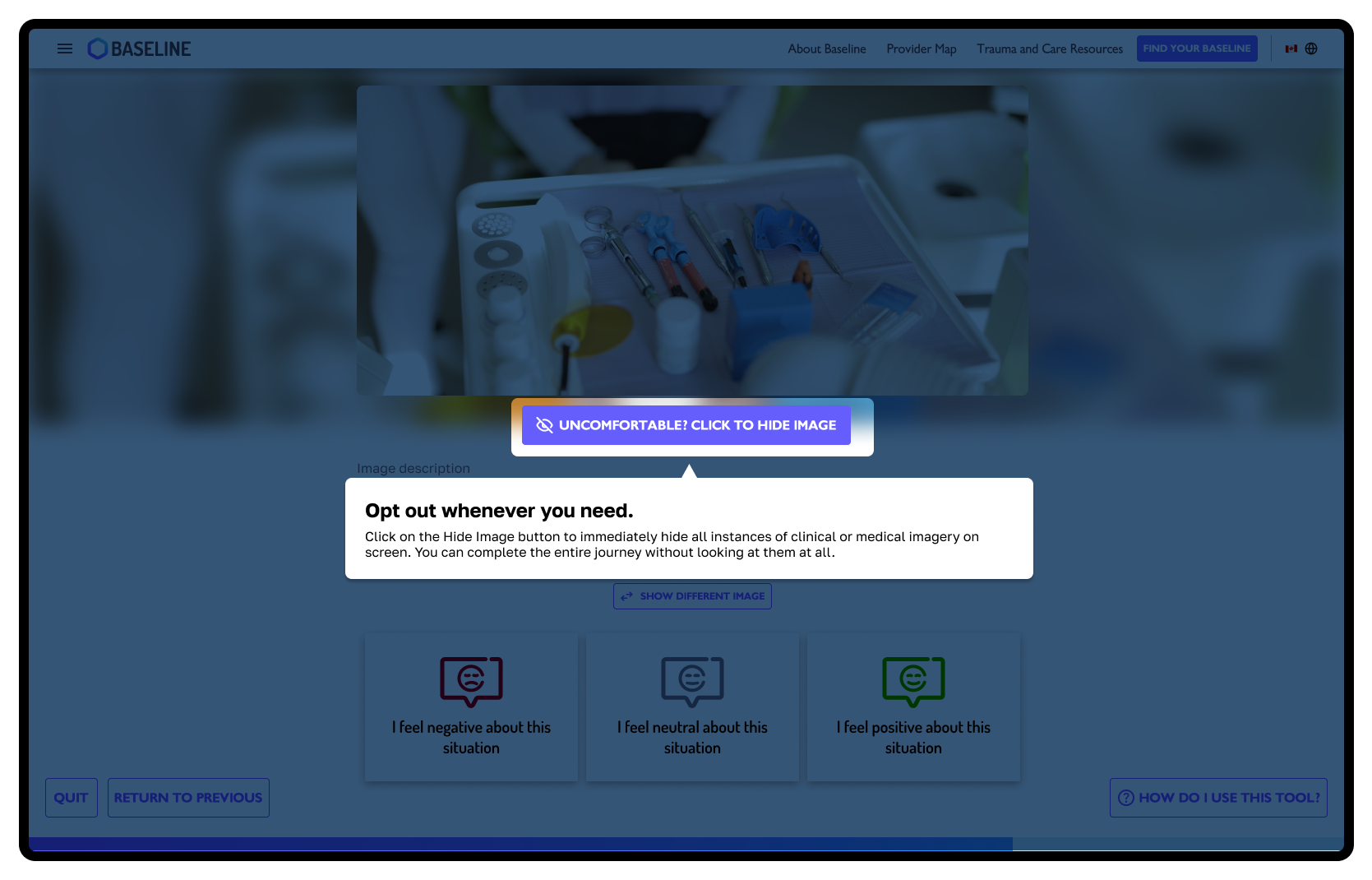
Baseline collects patient preferences and care needs through empathetic interaction, beyond traditional forms. By using ''Stimulus Images'', we allow a patient to actively react to the scene in front of them, without experiencing the real stimuli. This ''roleplay'' based approach allows patients to not only accurately identify the ''harder to explain boundaries'' they may have, but collect demographic data without invasive questions.
You're always going to be expected to be a part of this experience, so why not integrate your preferences directly into your search?
MATCHING WITH A CLINICIAN
Connecting complex care needs with compatible providers
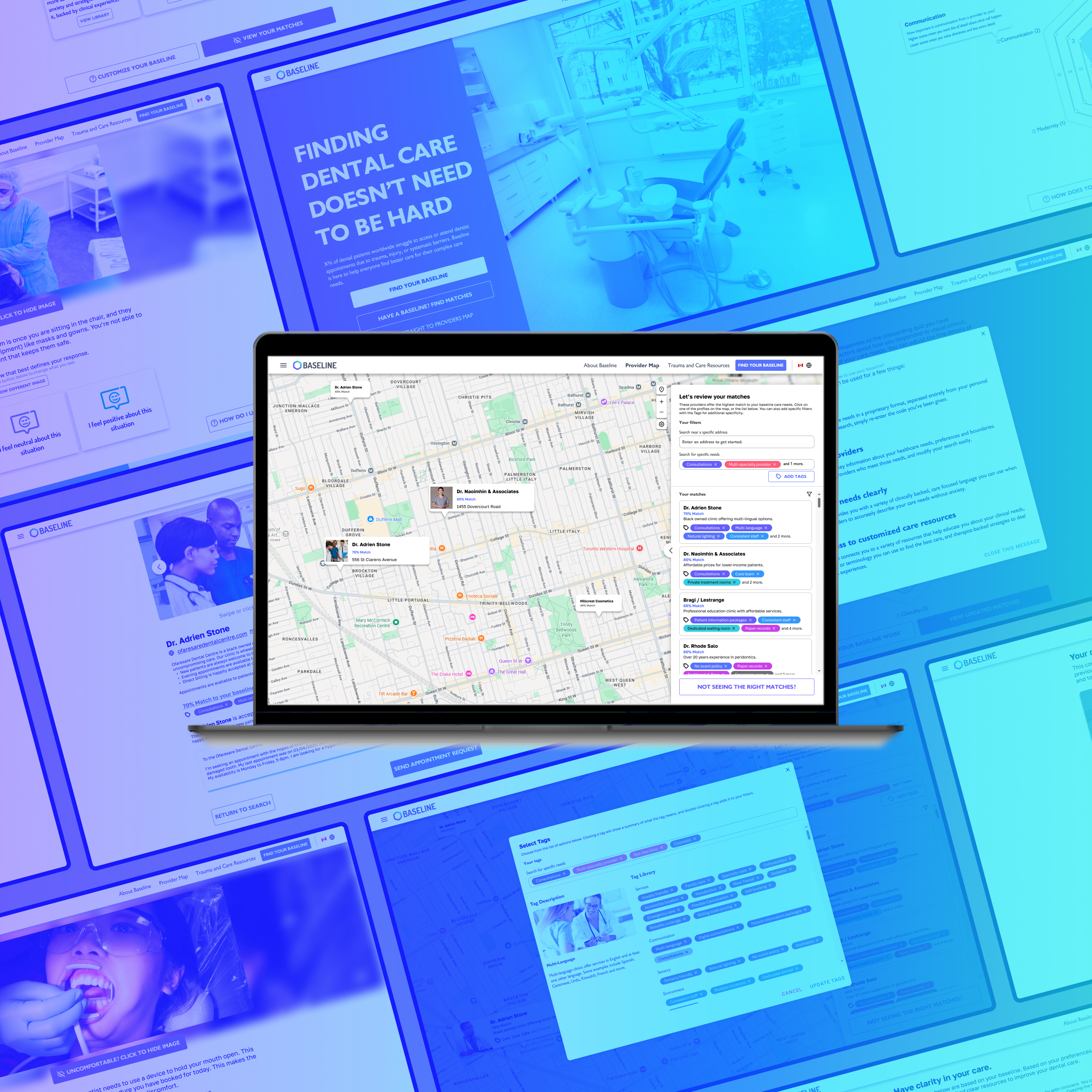
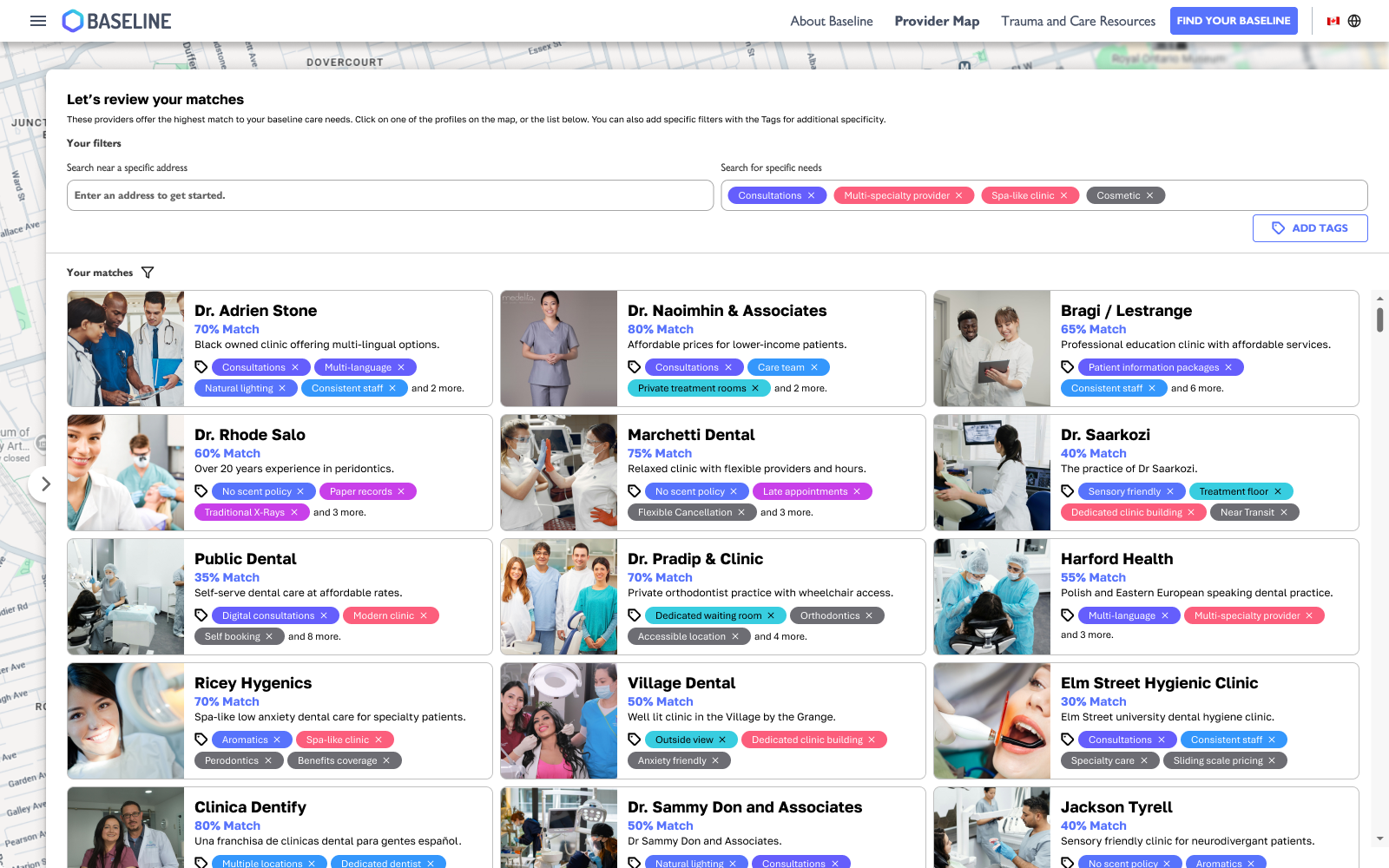
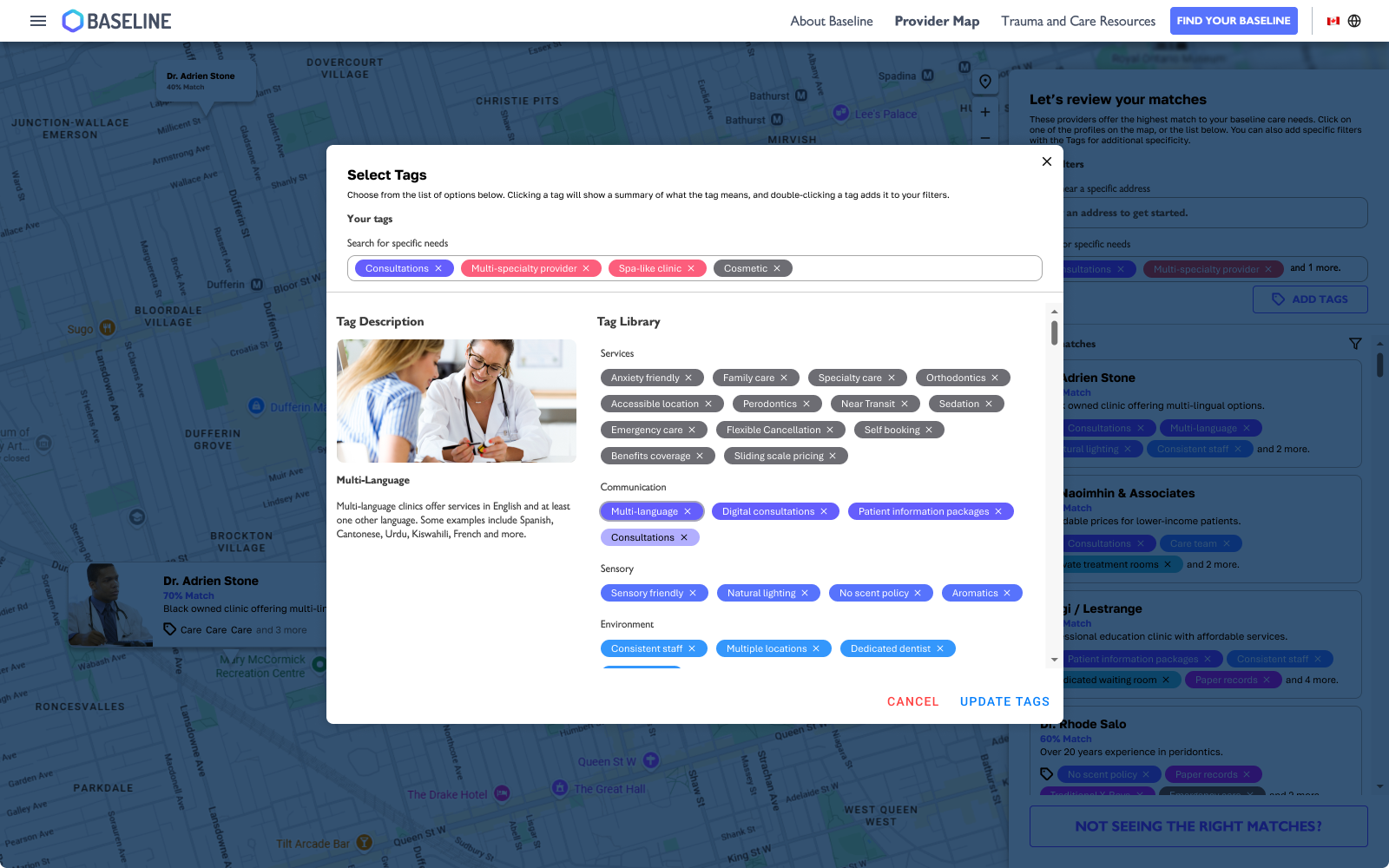
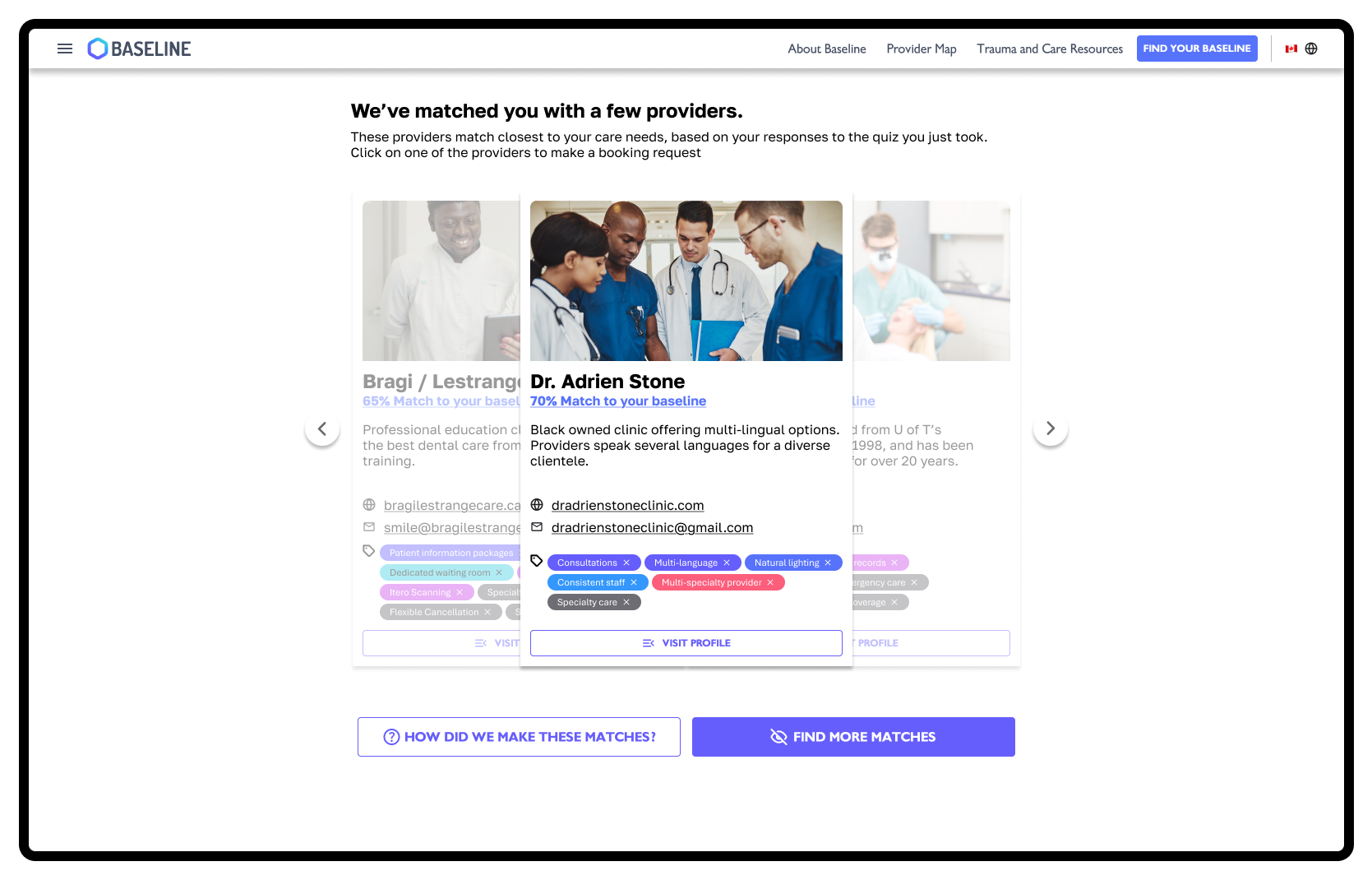
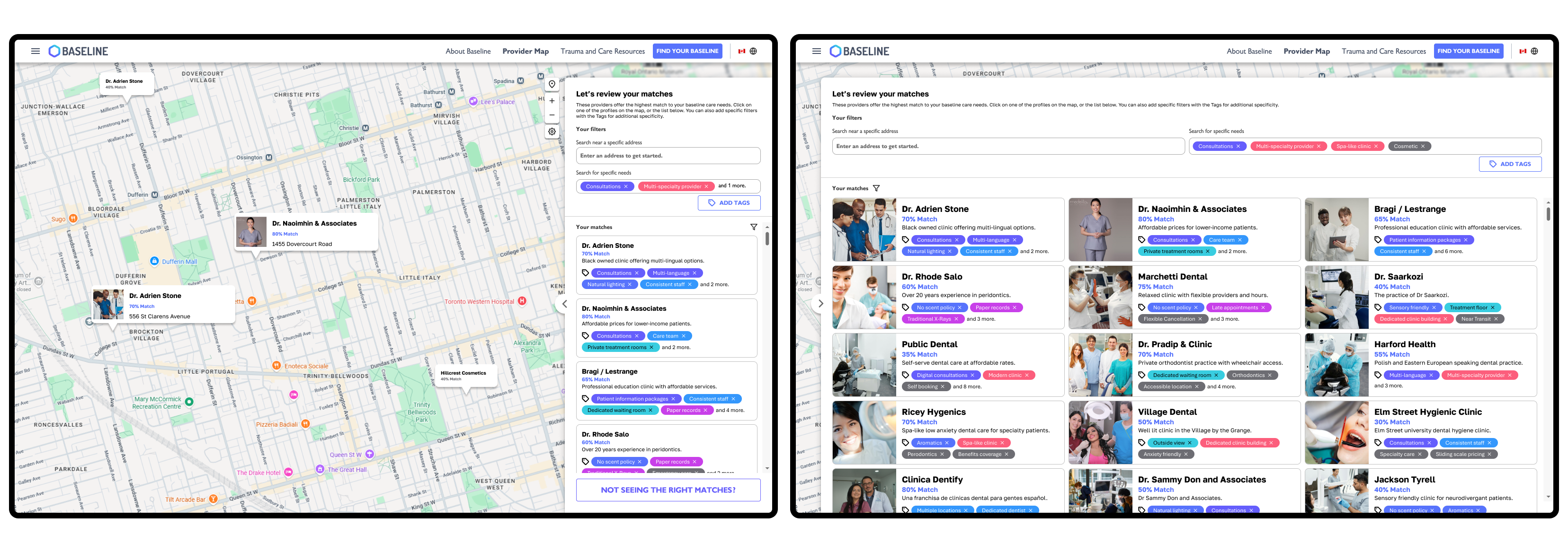
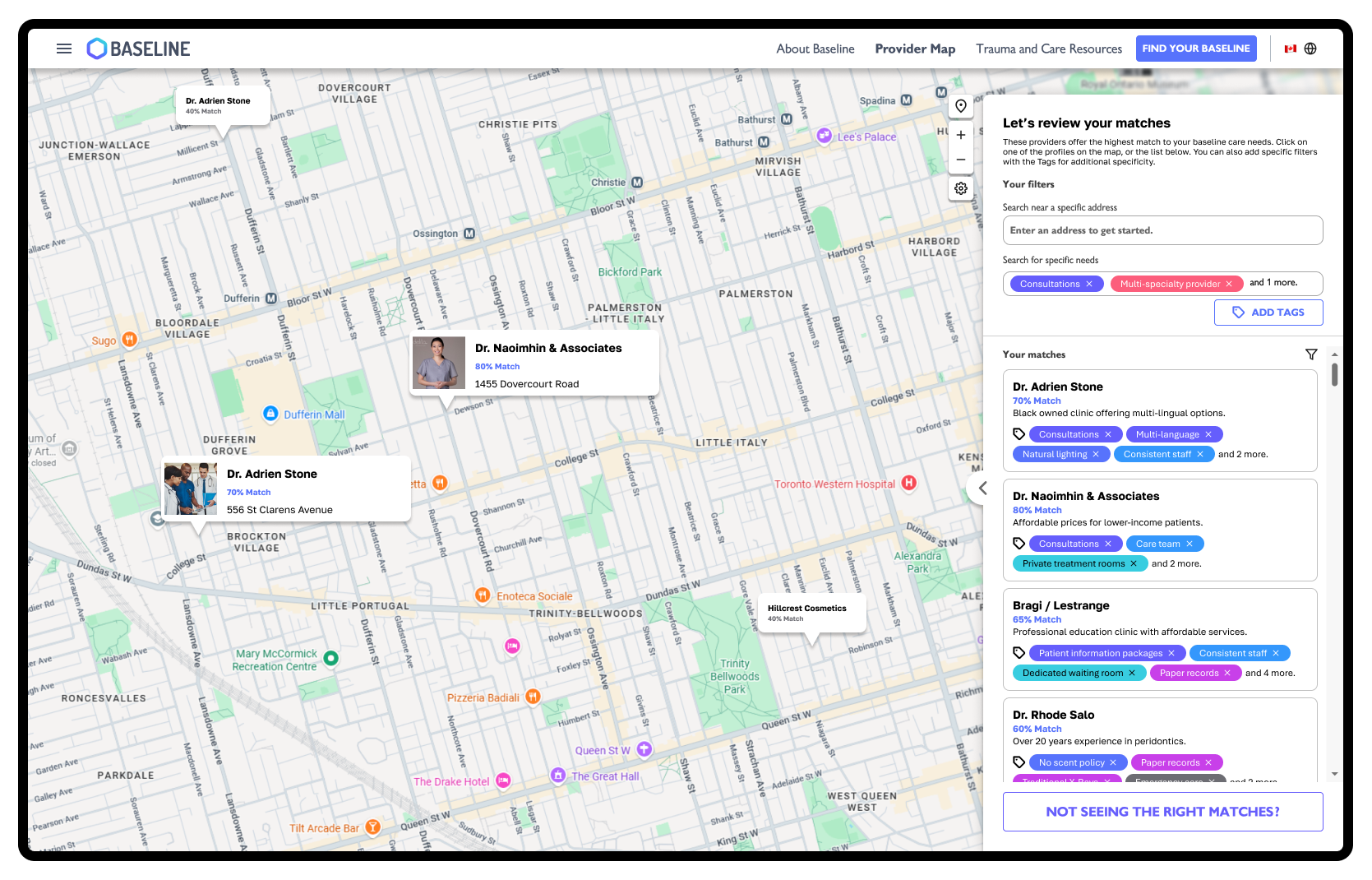
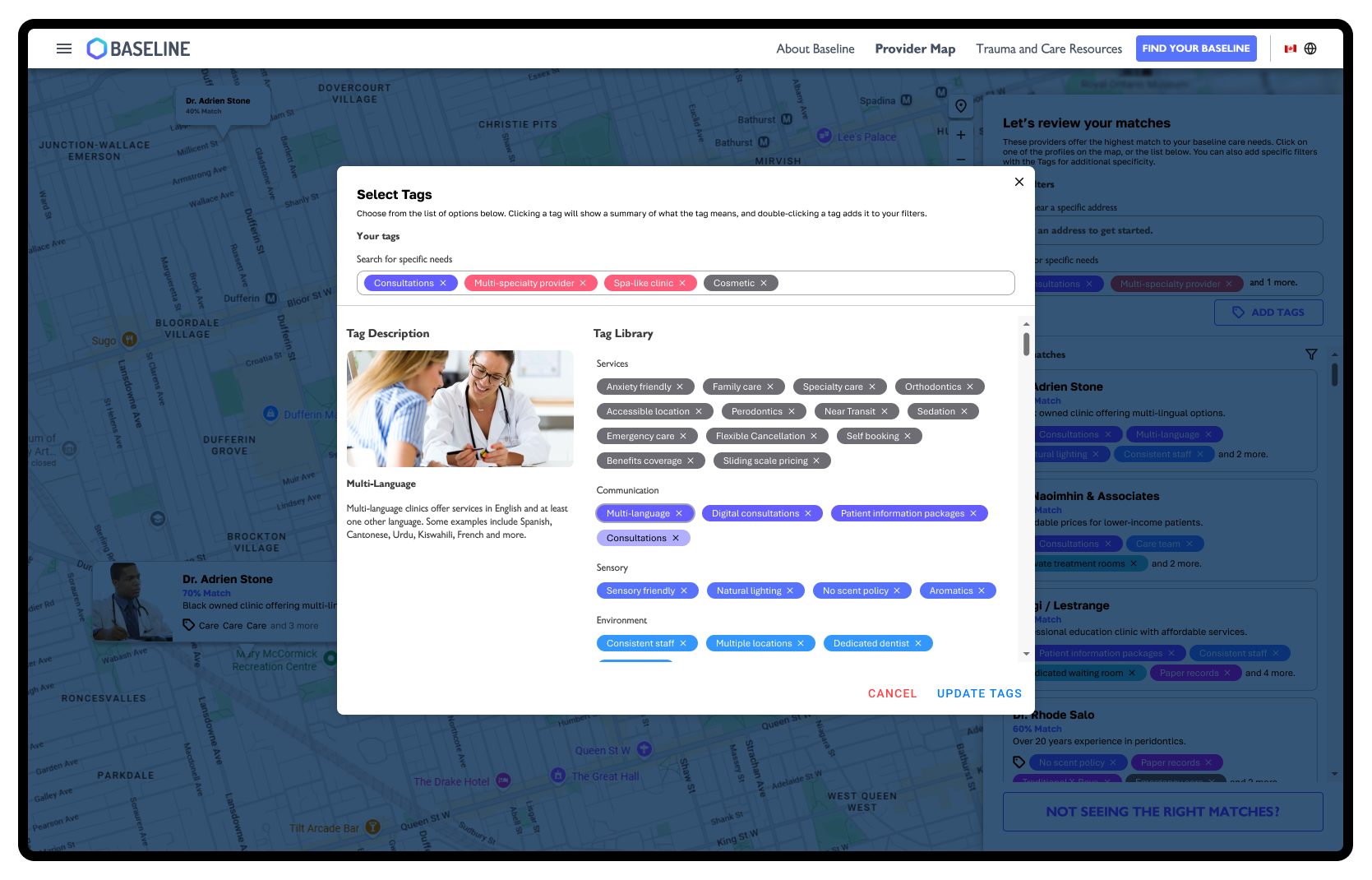
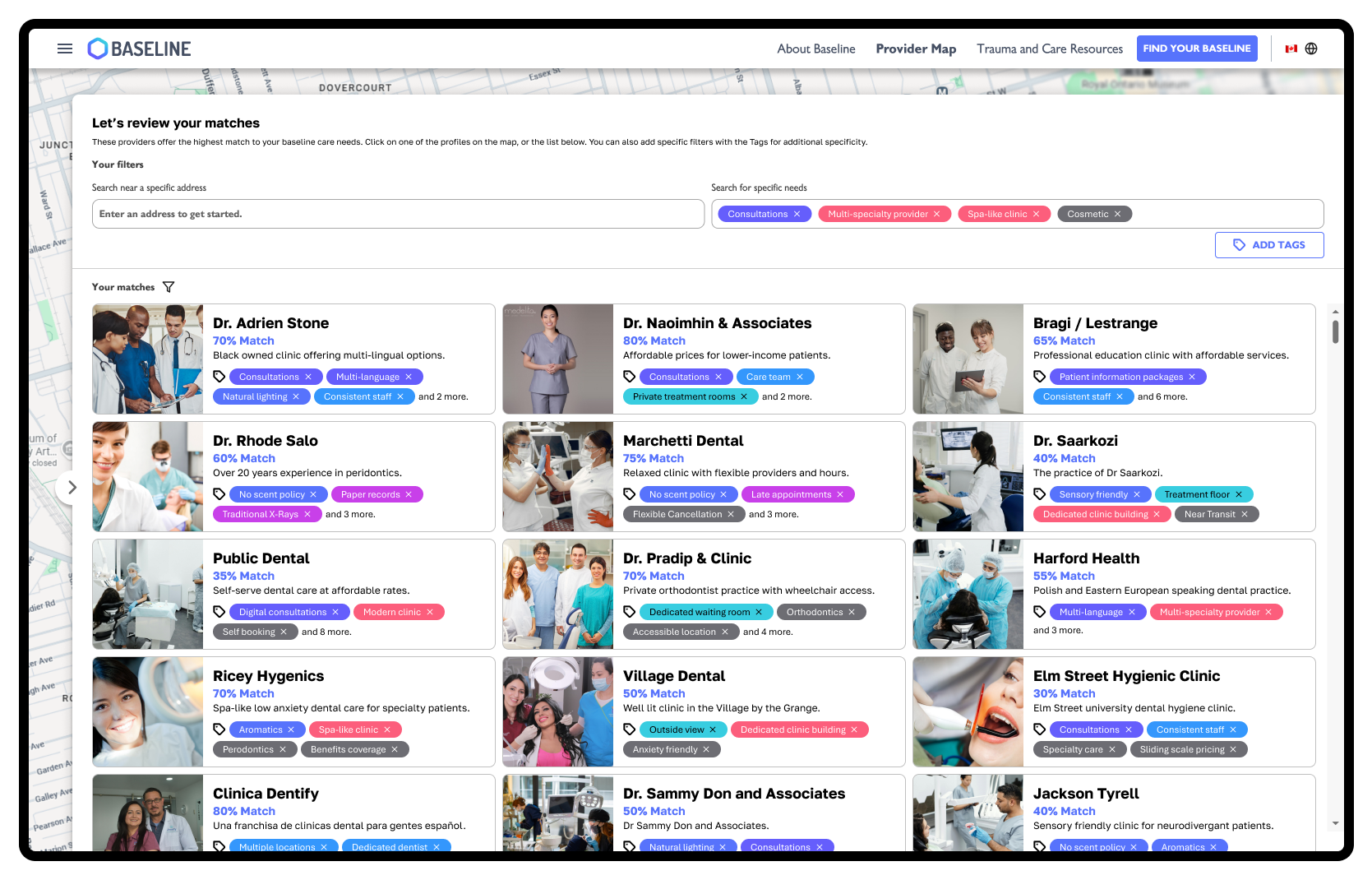
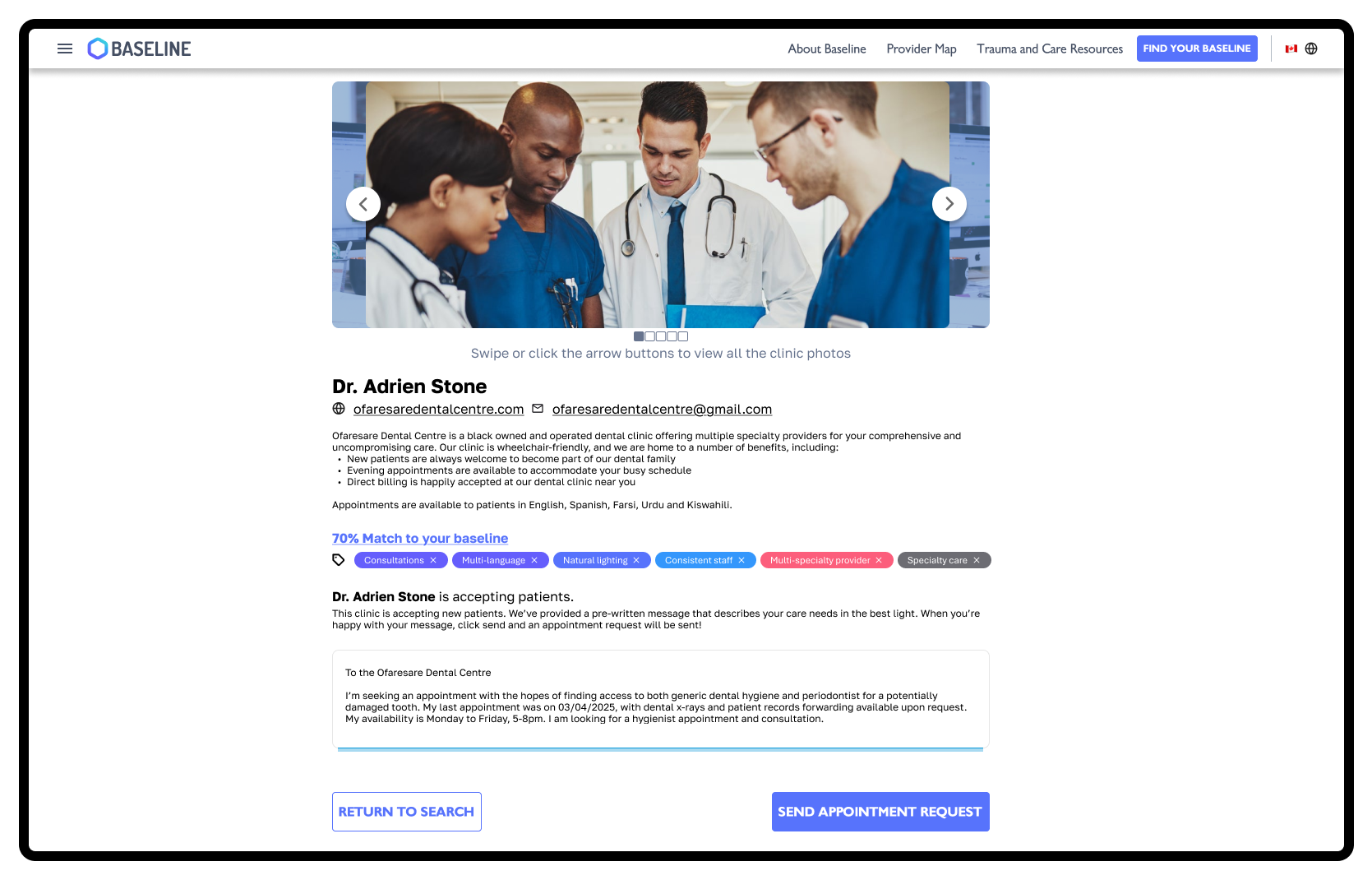
Patients are able to search for providers through a map-based search, combining proximity and preference. Patients can combine experiential needs with more specific requirements like language support and service type. By collecting care needs first, every provider that could provide relevant services already meets a patient’s experiential needs, allowing them to hone in on the perfect match.
DATA DRIVEN PROVIDER MATCHING - HOW IT WORKS
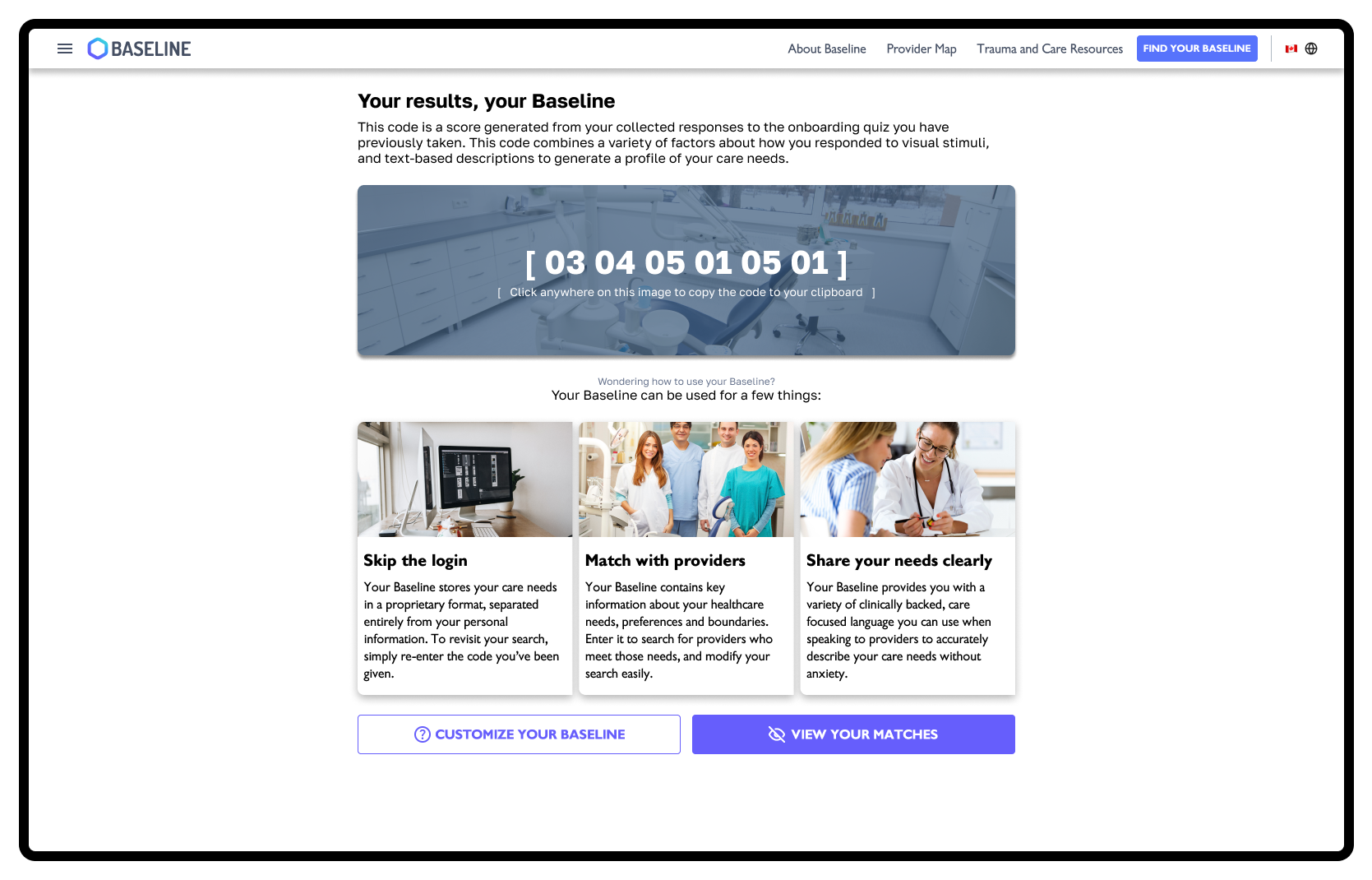
A single code for a comprehensive vision of your needs: the Baseline
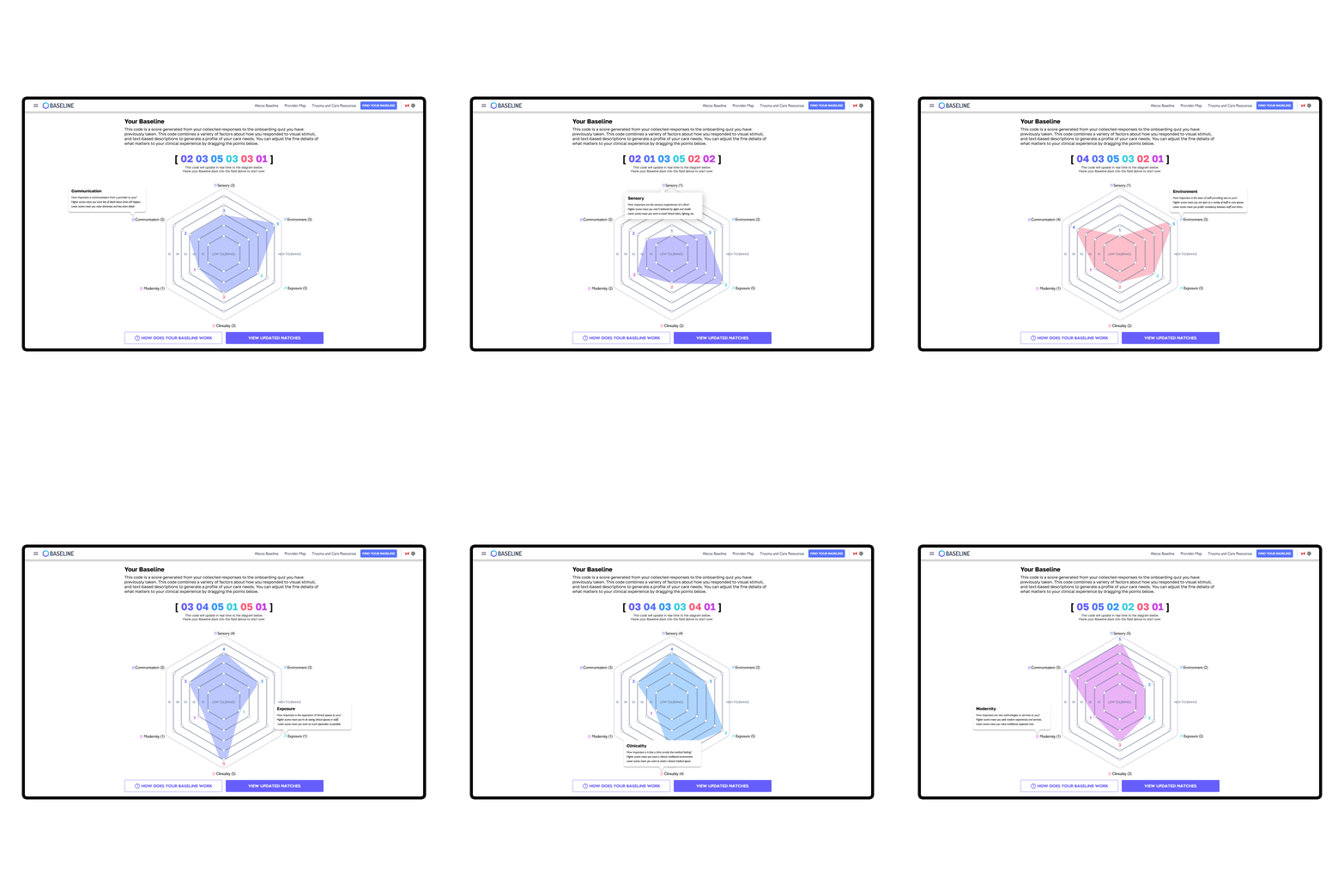
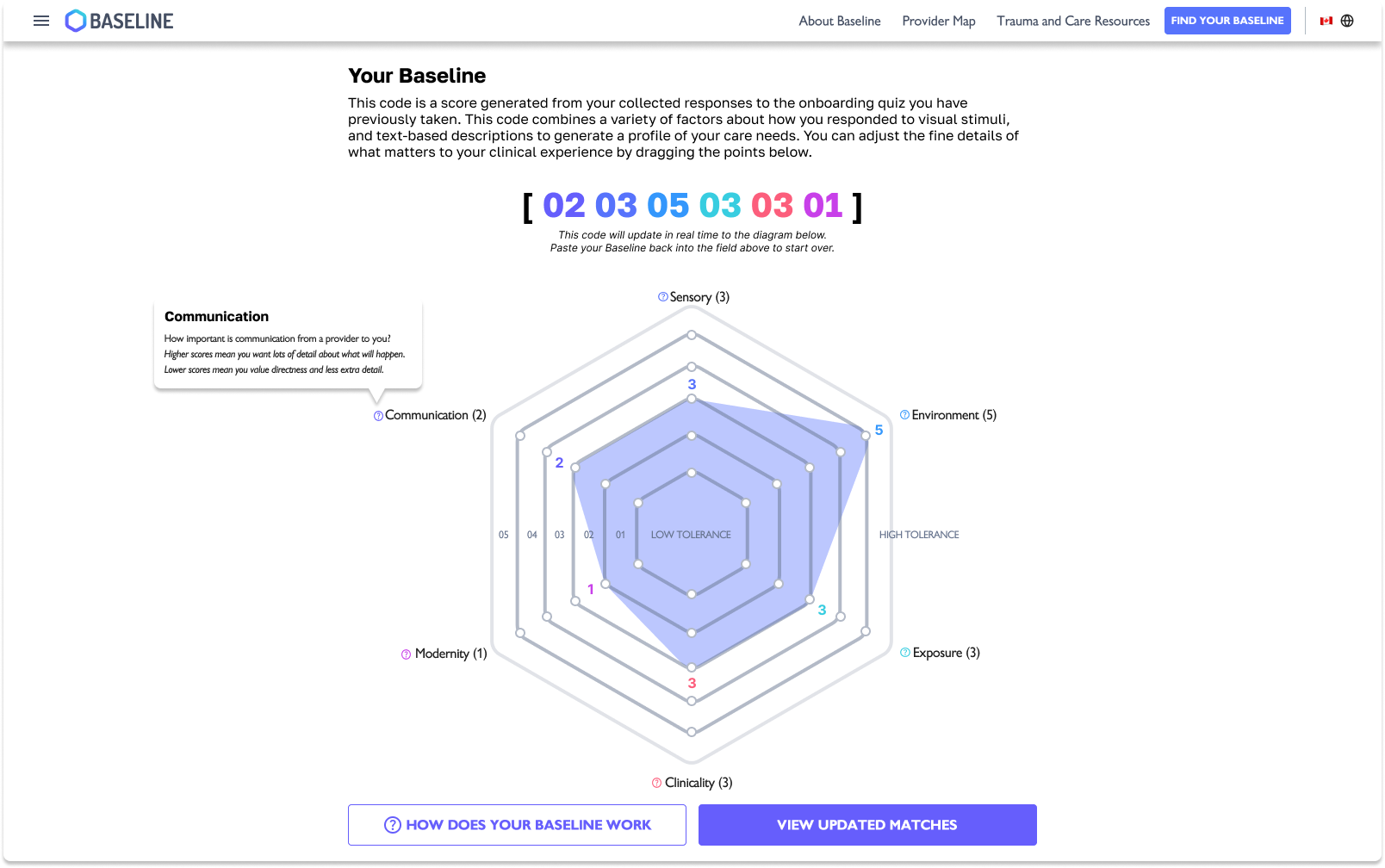
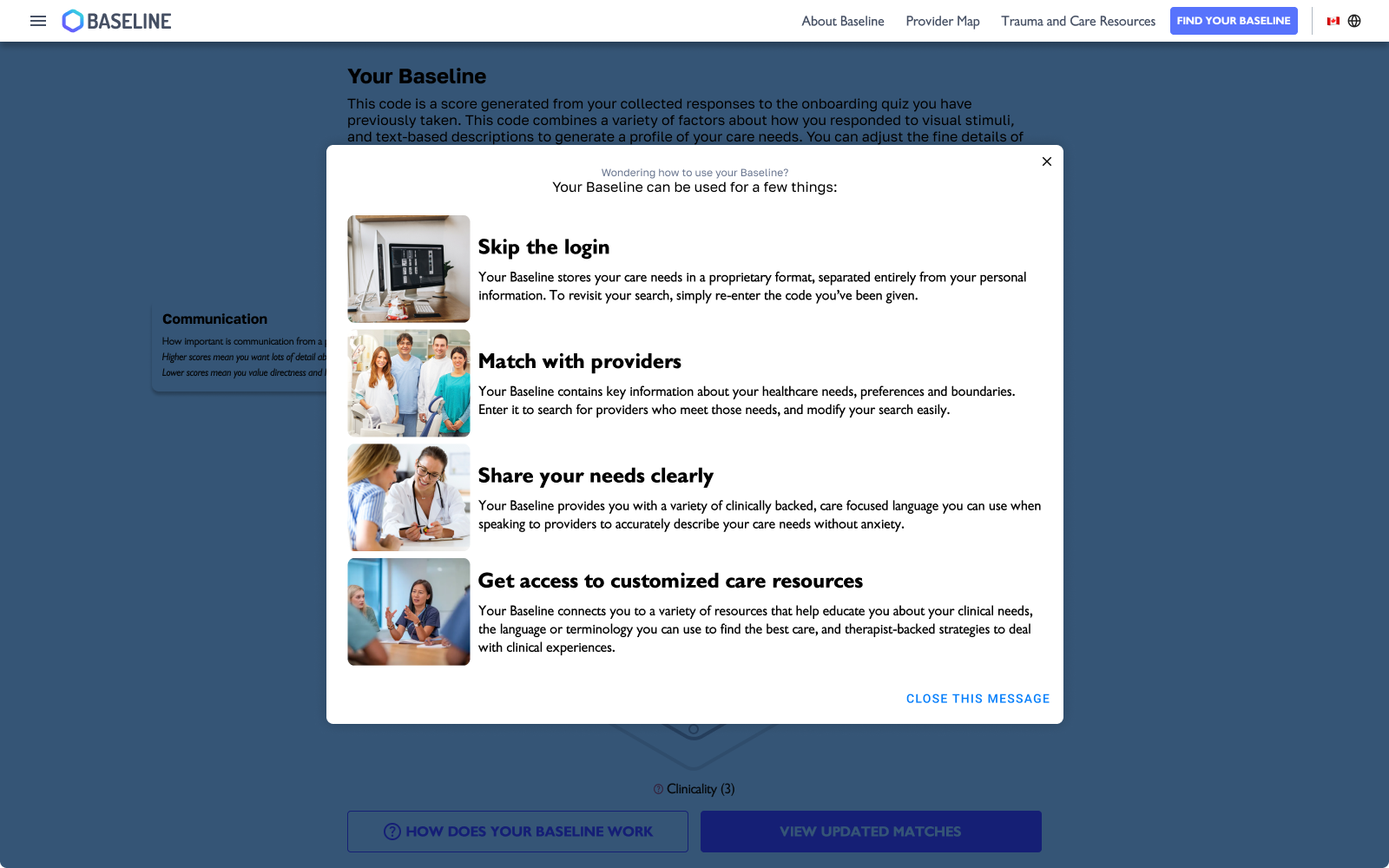
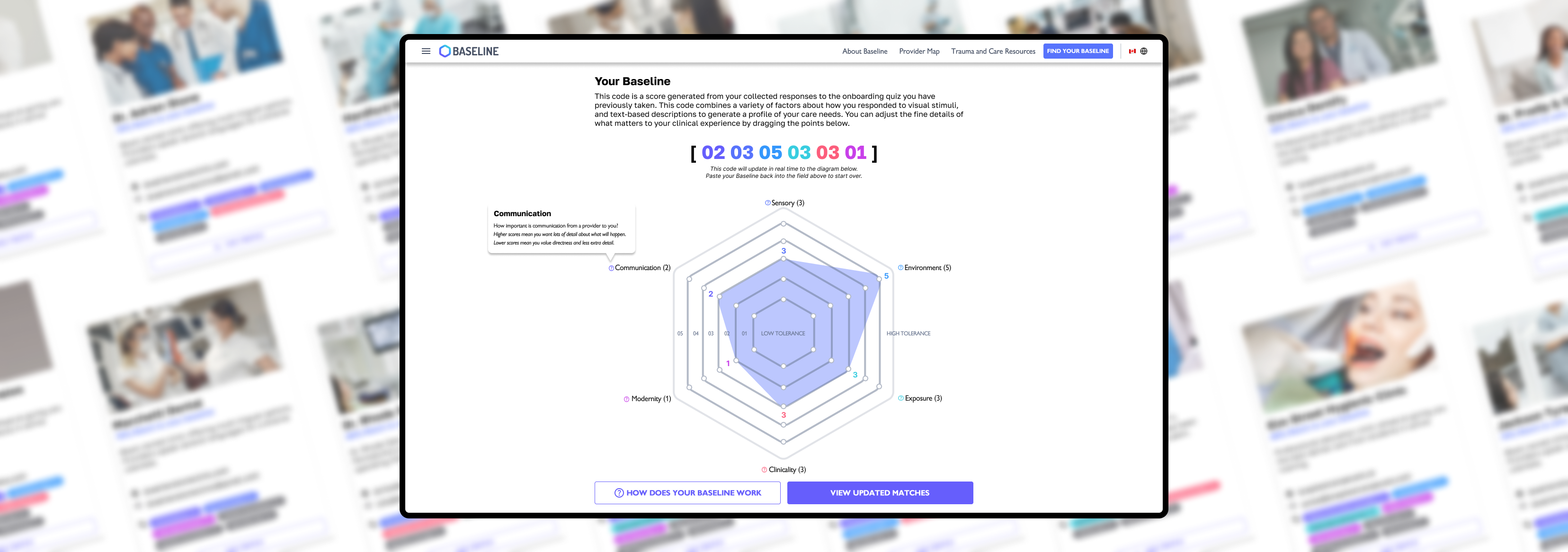
There is a unavoidable connection between patient needs and patient experience. When we try to separate those, healthcare becomes a complex, difficult and often traumatic environment. The stimulus images and user responses from onboarding are collected, categorized and generated into a core vision of what that patient’s care needs are, a ''baseline''
This baseline serves as a foundation that contains metrics to match a patient to providers that offer environments or care that match those needs, and does so without collecting any Patient Health Information (PHI).
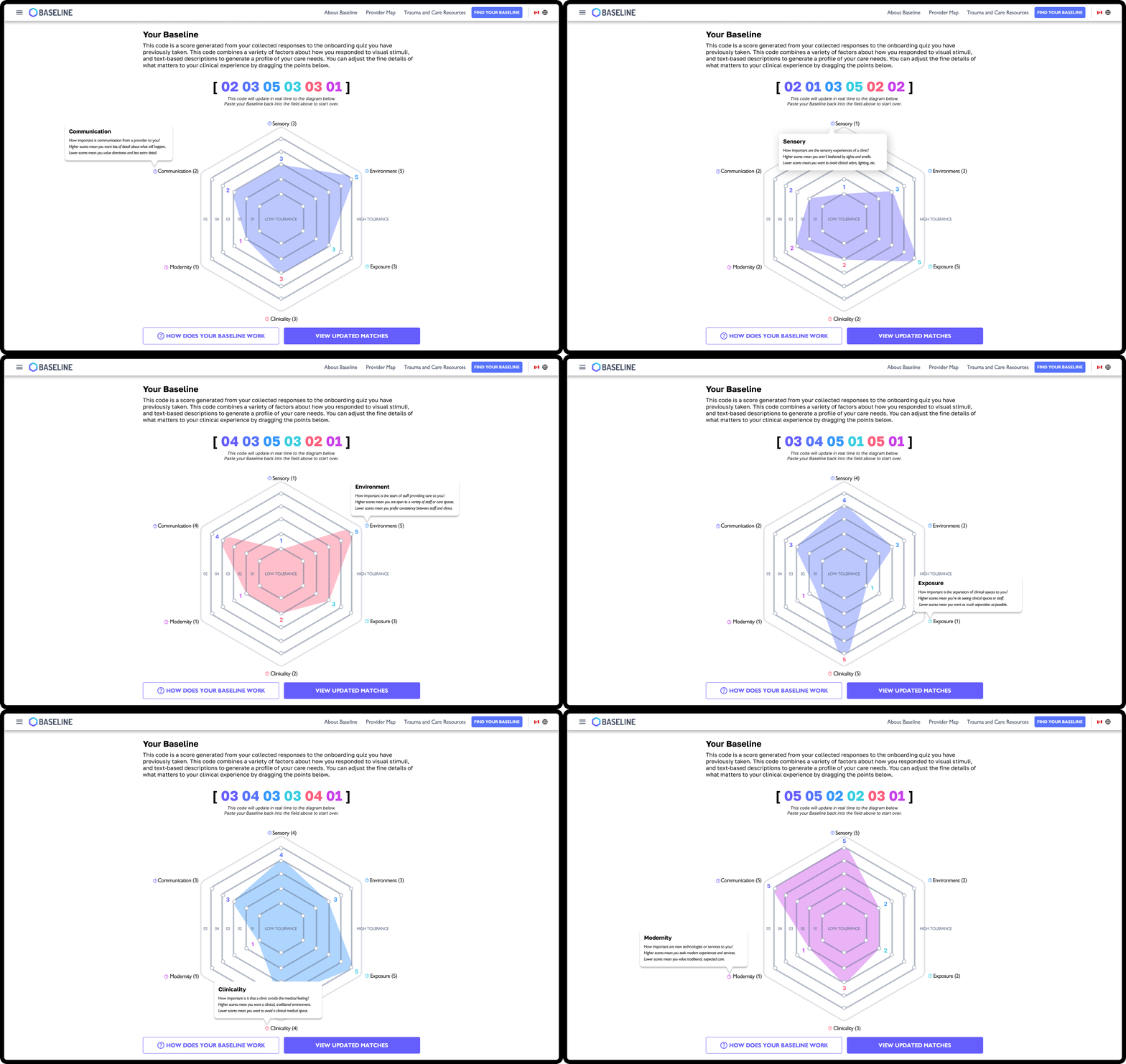
How it works: Turning quiz data into usable metrics
By mapping out 6 experiential trends in the dental care experience, we can derive preferences or needs to match patients and providers by what patient emotional needs are, instead of solely procedural ones. This allows patients to have experiences more congruent with their sensory, emotional, communicative and experiential needs, reducing difficult interactions and encouraging longer-lasting clinical relationships.
Each image in the onboarding quiz is weighted with a score, corresponding to values that gauge comfort with clinical information or experiences. The values are captured in numerical sequence, enabling patients to gain data-based help from emotionally-based responses.
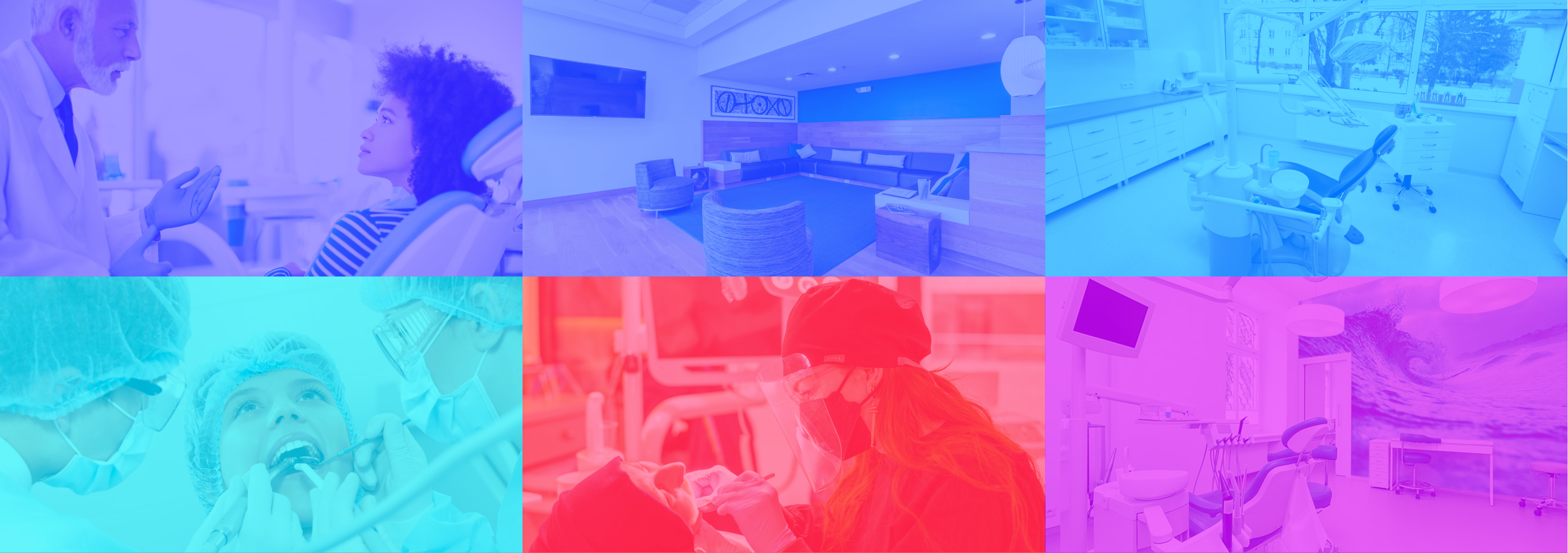
Metrics informed by clinical care
Patients are able to search for providers through a map-based search, combining proximity and preference. Patients can combine experiential needs with more specific requirements like language support and service type. By collecting care needs first, every provider that could provide relevant services already meets a patient’s experiential needs, allowing them to hone in on the perfect match.
Data was informed by first-hand research study with the University of Toronto’s Faculty of Dentistry library, and several local clinics participating in an experiential audit to identify and develop matching criteria.
OPPORTUNITIES
How do we do detailed patients/provider matching without a login portal?
Let’s face it: having to make new profiles, manage account access and login information for every different medical office you attend is frustrating. There’s no universal solution to different providers sharing the same patient access, or universal data types for EHR/EMRs.
So instead, I got rid of the concept. The information needed for finding providers contains no identifiable Patient Health Data (PHI), and doesn’t require storage. I leveraged read-only-memory cartridge data storage methodology from early video game consoles to create a finite ''password'''. This ''baseline'' converts the stimulus image and text responses into a code, which contains all relevant preferences. Tweakable, modular, and requiring ZERO patient data, we can match patients and dentists without another arbitrary account to find them.
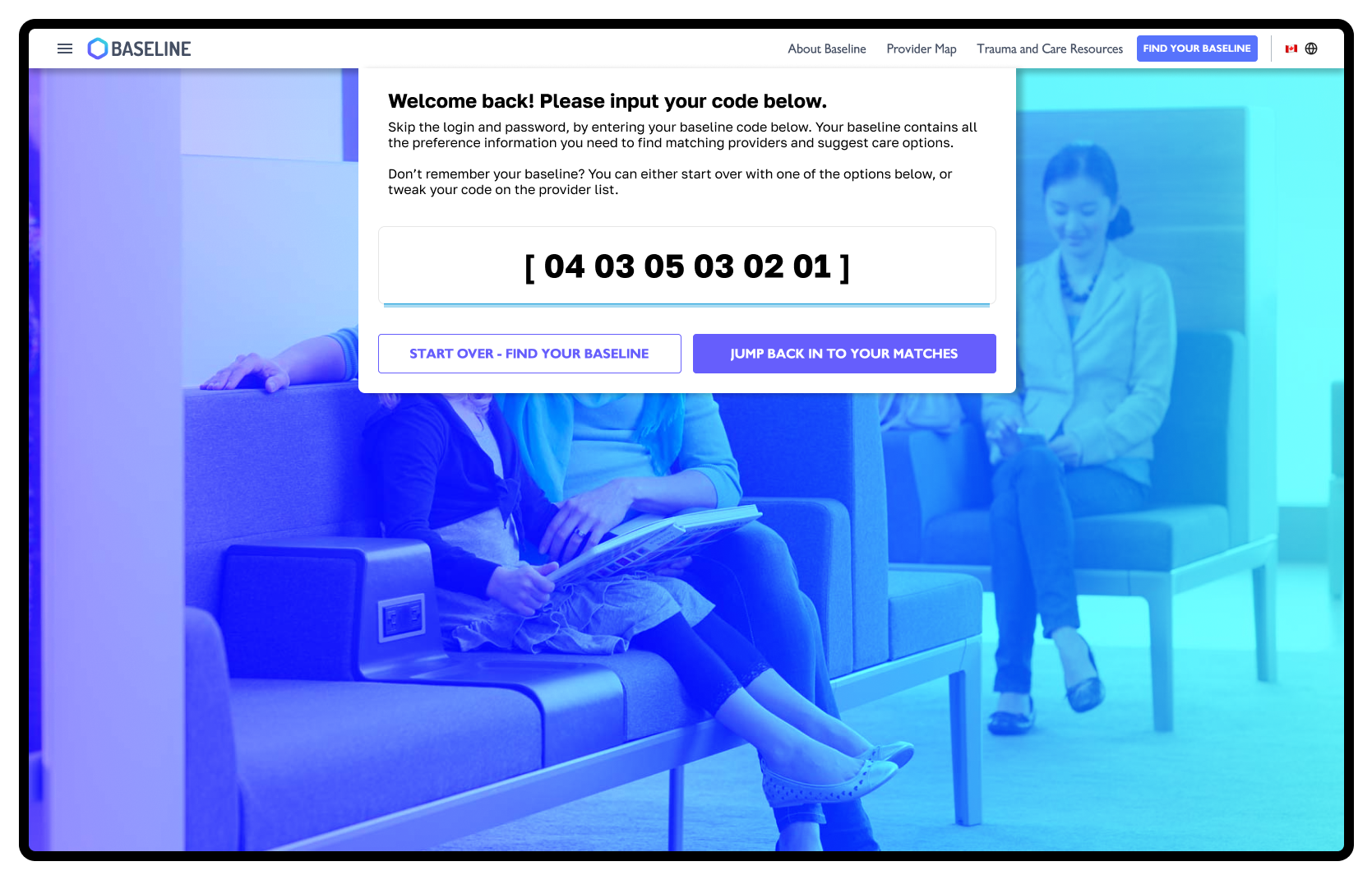

How can we match patients and providers with different goals?
By establishing a baseline for our patients, we identify the criteria they seek from the offices and providers they want to interact with. We’re then able to evaluate existing dentist through sentiment analysis of online reviews and webpage content to develop match criteria from the same metrics that form baseline codes.
By comparing patient baseline scores, and what providers offer, there will almost always be a gap. But for the providers and patients that have the same traits, the higher match scores serve to make lasting relationships and reduce clinical search times for patients.
How can we use experiential data to make better appointments?
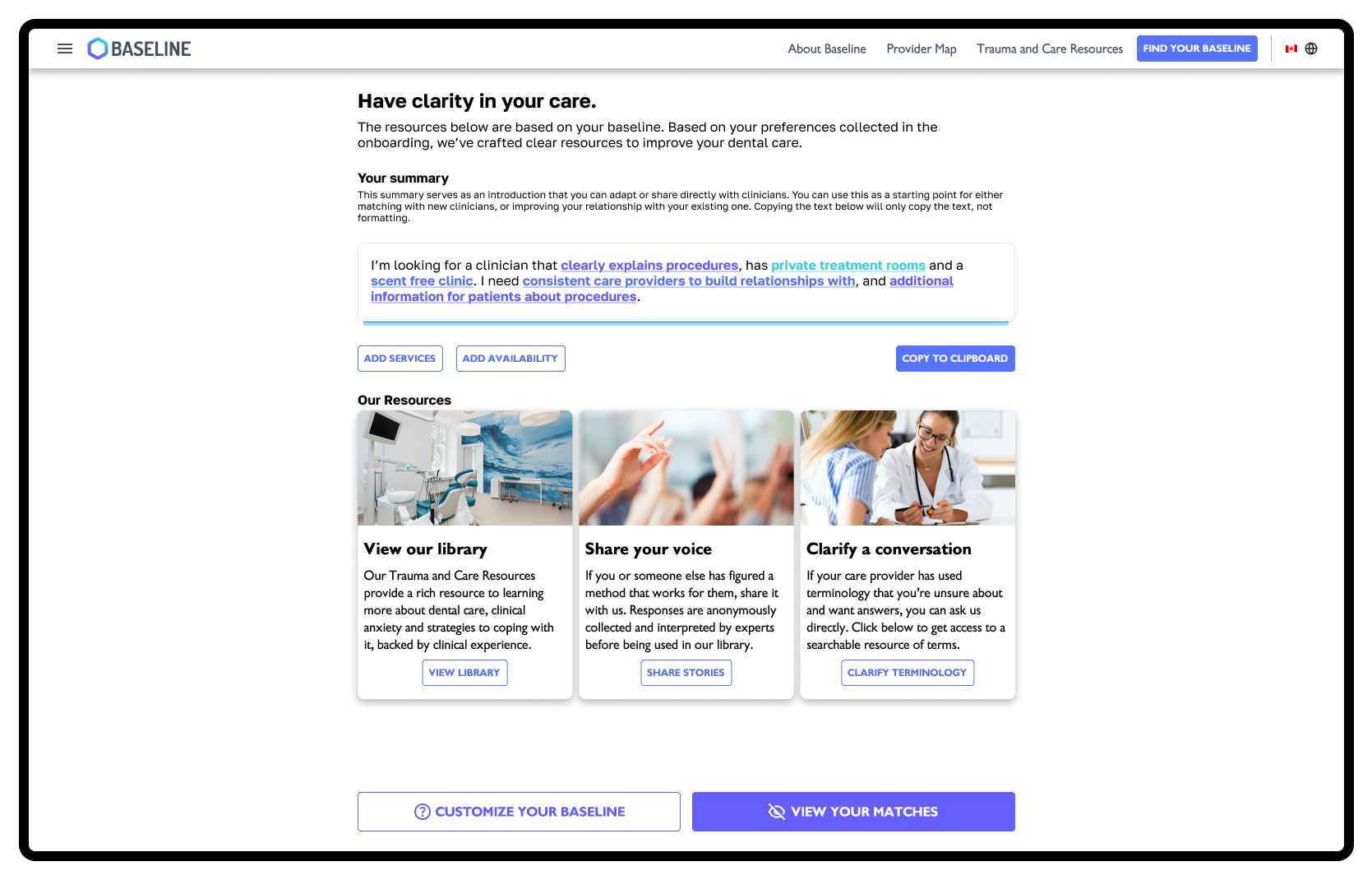
Baseline’s method of identifying experiential preferences in dental care experience doesn’t just provide the chance to match patients and clinics that will serve them best, but the data to refine that conversation. Many people struggle to communicate with healthcare providers because they lack the information or communication skills of a clinician, which is a totally unreasonable request. So to avoid that, and equip patients with the best possible knowledge around their needs, Baseline provides standardized language to communicate your needs clearly. A universal terminology makes consultations and expressing needs go so much smoother.
IMPACT

The case for alternative, experiential healthcare models.
There are ways to redefine healthcare through alternative lenses, and this project is an example of multiple experimental avenues for bridging these gaps.
Baseline aims to address barriers within care that emerge from communication boundaries, clinical trauma and avoidance, and provide access to an improved experience. It is proven that lower stress, better communication and clearer expectations improve all aspects of clinical care. Building healthcare products that aim to reduce the problems of a system rather than put the responsibility on already-occupied providers doesn't need to be revenue driven.
With all the challenges that exist in healthcare today, we need stronger tools that provide change in the right direction. Baseline aims to provide an opportunity for there to be less avoidance or access issues to dentistry by self-sorting patients, so that those who need the help most can get the care they deserve.
WORKS CITED
NHS Citation:''GP Patient Survey Dental Statistics; January to March 2016, England.'' NHS Choices. NHS, n.d Web. 13 June 2017
Stefanac, and Nesbit. Treatment Planning in Dentistry. N.p.: np.,n.d. Print
Calzavara, Nicole''First Impressions - Dental Research'' 2017. Web.
Bain, Crawford A. Treatment Planning in General Dentistry Practice - A Problem-based Approach. N.p.: Churchill Livingstone, n.d. Print
Laare, March, D.D.S Dr Lazare;s The Patient's Guide to Dentistry. N.p.: n.p.,n.d.Print.